

How to split firewood? Learn when an axe and splitting wedge are sufficient and when a log splitter becomes the more efficient option. Find out how to select a machine according to wood volume, log length and diameter, timber type and workflow, and how to organise a safer and more productive firewood-processing area.
How to split firewood?
Preparing firewood involves several stages: cutting logs to the correct length, splitting them into pieces, seasoning or drying them and storing them correctly. The splitting method should be matched to the quantity of material, log diameter and length, wood species and the organisation of the complete work area.
For small quantities, manual splitting with an axe or wedge may be sufficient. When several cubic metres of firewood are being prepared, however, mechanisation becomes increasingly important. Correctly selected log splitters reduce physical effort and make the process more repeatable.
Why does the method of splitting wood matter?
Correctly splitting firewood affects both storage convenience and the subsequent drying process. Split pieces expose more surface area to the air than whole rounds, allowing moisture to leave the wood more readily.
Splitting alone does not guarantee correct drying. Seasoning speed also depends on wood species, initial moisture content, piece thickness, air circulation, stacking method and protection from precipitation. Fresh wood needs to release moisture and should therefore not be sealed in an unventilated space.
The size of the finished pieces also matters. Oversized pieces may dry slowly and be awkward to fit into the firebox. Very small pieces are easier to ignite but burn more quickly. The dimensions should therefore be matched to the fireplace, stove or boiler in which the wood will be used.
It is also useful to plan the sequence of operations. In many cases, logs are first cut to the length required by the firebox and then split. This produces pieces of similar length that are easier to stack, transport and store.
Splitting firewood by hand
The simplest method uses a splitting axe, maul or suitable wedge. This approach is most practical for smaller quantities and logs that can be positioned and handled conveniently by hand.
Manual splitting requires no power supply or machine setup, but it quickly becomes physically demanding as volume increases. Log diameter, weight, wood species, grain direction and knots all affect the difficulty. A straight log may split with a single blow, while heavily knotted timber can require several wedges and considerably more effort.
A stable working area should be prepared for manual splitting. The log needs to stand so that it does not fall unpredictably when struck. Bystanders should remain outside the work area, and the operator should use suitable safety footwear and eye protection.
With larger quantities, fatigue becomes a limitation as well as time. Movement becomes less precise as the operator tires. For regular preparation of larger volumes, using a machine can therefore improve both workflow and ergonomics.
Log splitter – a more productive working method
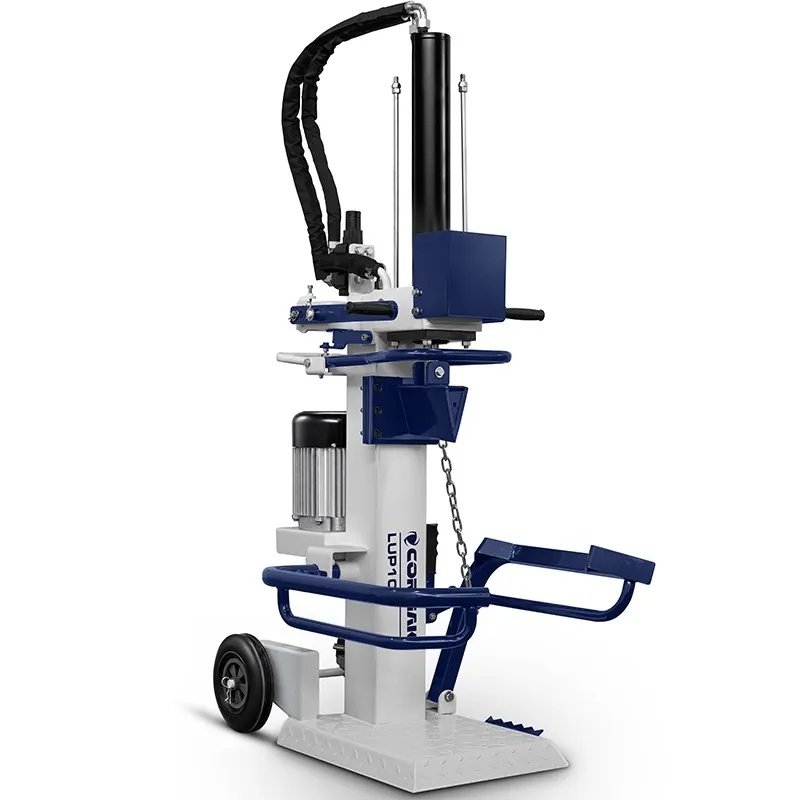
A log splitter divides a log using a mechanically or hydraulically driven wedge. In common electro-hydraulic designs, an electric motor drives the hydraulic pump and a cylinder produces the force needed for splitting. Petrol-powered models are also used where mains electricity is unavailable.
The main advantage is the ability to generate a high splitting force repeatedly without requiring the operator to provide the physical force for every split. The machine does not, however, eliminate all hazards. The log still needs to be positioned correctly and hands must remain outside the wedge's working zone.
CORMAK's log splitters and wood chippers range includes machines for household, agricultural and professional firewood preparation. Models differ in splitting force, maximum log dimensions, working orientation, power source and additional equipment.
Rated splitting force should not be the only selection criterion. Cycle time, ram return speed, stroke adjustment, working height, handling of heavy logs and machine mobility can all have a direct effect on productivity.
Where the process needs to include both cutting logs to length and then splitting them, firewood processors can be considered. They combine several firewood-preparation stages at one workstation and are particularly useful for larger volumes.
How do you choose a machine for preparing firewood?
A log splitter should primarily be selected according to the actual dimensions of the material and the quantity processed in a season or shift. Simply purchasing the machine with the highest advertised splitting force does not automatically produce the best solution.
Before buying, consider:
- the quantity of wood processed per session and per season,
- maximum log length,
- typical and maximum log diameter,
- wood species and how frequently heavily knotted logs are encountered,
- required splitting force,
- availability of 230 V or 400 V power or the need to work without mains electricity,
- horizontal or vertical working orientation,
- cycle time and ram return speed,
- log lifter, side tables, four-way wedge and transport wheels,
- available space for operation and storage.
For seasonal preparation of smaller quantities, compact machines are often sufficient provided their permitted log length and diameter match the material. Thick, hard or heavily knotted wood may require greater force reserve and a more stable machine construction.
In professional production, splitting force is only one factor. Overall cycle productivity, loading and unloading ergonomics and integration with other equipment become increasingly important. A firewood processor can reduce the amount of manual handling required between separate cutting and splitting stations.
The stage after splitting should also be planned. Finished pieces should ideally move directly to a location suitable for further drying and convenient later handling. A fast splitter offers limited benefit if the processed wood then has to be moved repeatedly by hand.
Preparing firewood safely for winter
Whether firewood is split manually or by machine, the workstation should be stable and level. The operator should wear suitable work footwear and eye protection and, when operating machinery, any protective equipment specified by the manufacturer.
Before starting a log splitter, check the working components, guards, hoses and controls. Two-hand controls or other safety systems should never be blocked or bypassed. The log must be positioned as specified in the operating instructions and hands must remain outside the wedge and moving-component areas.
If material becomes jammed, stop and secure the machine before attempting to remove it, following the manufacturer's procedure. On hydraulic systems, never search for a suspected leak with your hand, because high-pressure fluid can cause serious injury.
Handling ergonomics also matter with large and heavy logs. A log lifter, side table or suitable handling equipment can reduce manual lifting. Holding an unstable log by hand while the splitting wedge is moving is not an acceptable way to increase productivity.
Safe firewood preparation does not end once the wood has been split. Logs should be stacked securely for drying, protected against stack collapse and stored so that air can circulate. Good material-flow planning reduces unnecessary handling and improves the entire workflow.
Summary
Firewood can be split manually or with a log splitter. For small quantities, an axe and wedge may be sufficient, but as the workload increases, machine productivity, ergonomics and process repeatability become more important.
A log splitter should be selected according to the actual dimensions and type of timber rather than only a single splitting-force figure. Log length, diameter, cycle time, material handling, power supply and additional equipment all have a direct effect on usability.
At larger scale, it is worth treating firewood preparation as a complete process: cutting to length, splitting, transport, drying and storage. Well-coordinated stages reduce manual handling and allow firewood to be prepared in a much more organised and productive way.
