

Pallet strapping helps stabilise goods for transport and storage. Learn how to choose polypropylene (PP), polyester (PET) or steel strapping, position the bands correctly and protect packaging edges. Discover how a strapping machine works and when combining pallet strapping with stretch wrapping provides additional protection.
Proper load securing is essential for efficient transportation and safe storage. This applies to large palletised loads and smaller shipments alike. Pallet strapping stabilises goods using appropriately tensioned bands, helping to reduce product movement, separation of grouped packages and damage to packaging.
However, effective securing depends on the chosen material, strap positioning, tension and the quality of the joints. The stability of the pallet itself and the conditions during subsequent transportation must also be considered.
What is pallet and parcel strapping?
Strapping involves placing a suitable band around a load, applying controlled tension and securely joining the ends. Common materials include polypropylene (PP), polyester (PET) and steel. The choice depends on the goods' weight, dimensions, rigidity, characteristics and the required strap strength.
PP strapping is commonly used for cartons and lighter product bundles. PET strapping may be suitable for heavier loads requiring greater strength and elasticity. Steel strapping is used in selected industrial applications, particularly for extremely heavy and rigid components. The chosen band must be compatible with the strapping equipment and joining method.
Parcel strapping holds together cartons, product bundles and grouped packages. On pallets, the straps stabilise individual layers. If the goods must also be secured to the pallet, the straps need to pass around appropriate parts of the pallet base rather than simply encircling the stack of cartons.
Strapping can be used independently or combined with stretch film. The bands provide mechanical restraint, while stretch film helps group smaller packages and limits exposure to dust and dirt. Standard stretch wrapping does not, however, automatically provide a completely waterproof barrier.
How to strap pallets correctly
Effective pallet strapping begins with a properly arranged and stable load. The pallet should be undamaged, the products securely positioned and the centre of gravity as low as reasonably possible. Heavy items should generally be placed in the lower layers, avoiding excessive overhang beyond the pallet edges.
Before strapping, select a band with suitable strength, width and thickness. Position the straps to prevent movement without twisting them, passing them across unprotected sharp edges or applying so much tension that the packaging becomes deformed.
For a small number of pallets, manual tensioners and portable tools may be sufficient. Where larger quantities are regularly prepared for dispatch, consider strapping machines for PP and PET bands. Tabletop machines designed for cartons should be distinguished from equipment specifically intended for pallet loads.
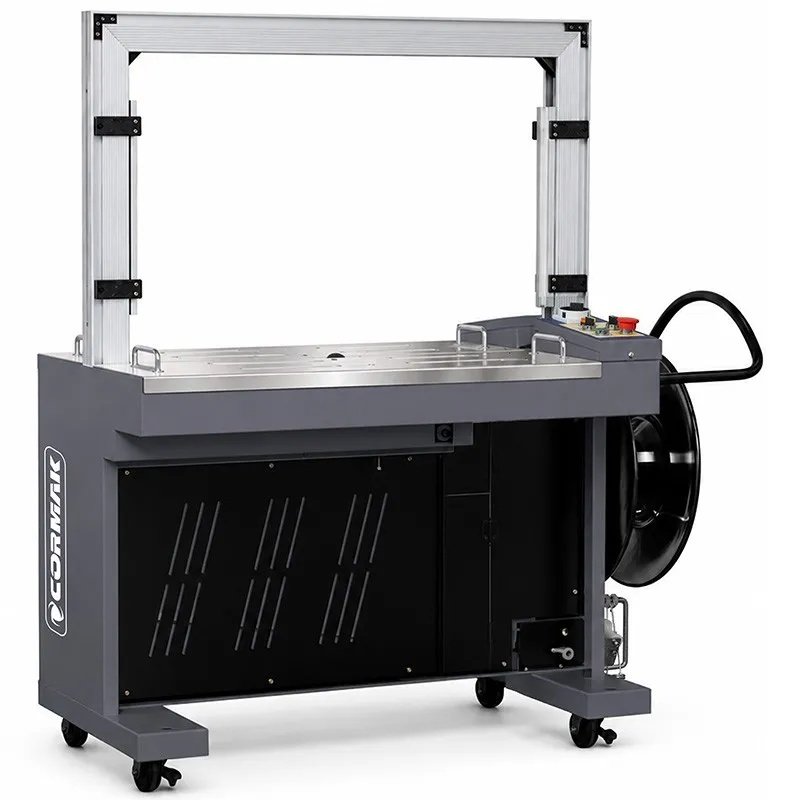
One example is the CORMAK BA1310 semi-automatic pallet strapping machine. It processes PP strapping with a width of 9–16 mm, uses heat sealing and features a lowering strap guide that helps feed the band beneath the pallet. Adjustable tension allows the process to be adapted to different goods.
The number of straps depends on load height, weight, shape and transport conditions. A single strap may be insufficient for a tall or irregular palletised load. Frequent handling and substantial vibrations may require additional points of restraint.
Edge protection and joint inspection
Protective corner pieces distribute strap pressure and reduce the risk of damage to both cartons and the band. After strapping, check tension, positioning, load stability and the quality of the welded joint or buckle closure. A weak connection can compromise the effectiveness of the entire securing arrangement.
How does a strapping machine work?
A strapping machine tensions the band and joins its ends. The degree of automation depends on the machine's design. Manual, battery-powered, semi-automatic and fully automatic systems are available.
With a semi-automatic machine, the operator places the strap around the package and inserts its end into the equipment. The machine then tensions, heat-seals and cuts the band. Automatic arch strapping machines also feed the strap around the carton or bundle. Pallet machines use guides designed for larger loading units.
For irregular loads, the CORMAK JDSA battery-powered strapping tool may be useful. It handles PP and PET bands 13–16 mm wide and 0.4–1.2 mm thick. Its tensioning force is adjustable from 900 to 3200 N, and the ends are joined by friction welding.
When selecting a machine, check strap compatibility, tensioning range, joining method, package dimensions and weight, and the planned number of cycles. A packing station for lightweight cartons requires different capabilities from a system handling heavy palletised goods.
Pallet strapping versus stretch wrapping
Strapping and stretch wrapping perform related but distinct functions. Straps provide a mechanical connection between products, while film brings smaller packages together and adds a protective layer against dust and dirt.
Many warehouses combine both methods. Once the load has been strapped, it can be wrapped using a pallet stretch wrapping machine, provided this sequence suits the packing process. Correct film tension, the number of wraps and a secure connection to the pallet base are important.
For smaller shipments, parcel and carton wrapping machines can provide more consistent results while reducing the need to handle rolls of film manually.
Neither strapping nor stretch wrapping replaces proper load restraint inside the transport vehicle. Keeping products together on a pallet and securing the complete pallet during a journey are separate tasks that require suitable measures.
Common pallet strapping mistakes
Incorrect strapping may fail to provide the expected stability. Frequent mistakes include:
- insufficient strap tension;
- using strapping with inadequate strength;
- incompatibility between band and machine;
- unevenly positioned straps;
- strapping unstable stacks of goods;
- excessive tension that deforms cartons;
- failure to protect sharp edges;
- poor heat seals or incorrectly closed buckles;
- neglecting equipment inspection and maintenance.
High tension alone does not guarantee safety. Light cartons, heavy industrial components and irregularly shaped goods require different securing arrangements. Machine settings should match the goods and the instructions provided by the strap and equipment manufacturers.
Operators should wear the required protective equipment and keep their hands clear of tensioning, cutting and sealing mechanisms. Before beginning regular production, carry out a trial strapping cycle and check both load stability and packaging condition.
Summary
Pallet strapping improves load stability and helps prepare goods for transport and storage. The essential factors are choosing suitable strapping, positioning it correctly, controlling tension, protecting edges and inspecting joint quality.
Select equipment according to the strap material, package dimensions and frequency of use. Automation can improve consistency when processing larger volumes. Combining strapping with stretch film may provide additional stability and protection.
Before introducing a solution, evaluate the complete packing process, from building the pallet to securing the loading unit for transport. This can help reduce damage, improve workplace ergonomics and ensure that the equipment meets the warehouse's actual requirements.
