

Removing rust with dry ice can help clean surfaces affected by loose corrosion deposits, oil and industrial residues. Discover how dry ice blasting works, its limitations and when abrasive blasting or laser cleaning may be more suitable. Learn how to select the appropriate equipment and prepare a safe working environment.
Rust is a common problem affecting steel components, machinery, structures and industrial equipment. The cleaning method should be selected according to the type of corrosion and the desired result. Dry ice blasting can remove many contaminants without introducing conventional abrasive media, but it cannot replace every rust removal process. Further details are available in the guide dry ice cleaning – how does it work and what are its applications?.
How does dry ice cleaning work?
Dry ice is solid carbon dioxide (CO₂). At atmospheric pressure, it sublimates, changing directly from a solid into a gas. During cleaning, dry ice pellets are accelerated by compressed air and directed through a nozzle towards the contaminated surface.
Particle impact, temperature differences and sublimation help weaken the adhesion of deposits and separate them from the substrate. Unlike conventional abrasive blasting, the process does not leave behind spent sand or mineral blasting media. However, the contaminants that have been removed still need to be collected, including rust, coating fragments and oily deposits. The absence of waste from the cleaning medium does not mean that the entire operation is waste-free.
Removing rust with dry ice – what is possible?
The pellet stream can dislodge loose corrosion products and dirt from rusted components. The method is primarily suitable for deposits with weak adhesion, rather than being a universal substitute for intensive mechanical rust removal.
The outcome depends on the thickness and adhesion of the layer, the condition of the metal, pressure, pellet feed rate, nozzle and operating technique. Simply describing rust as light does not guarantee its complete removal. Before a large project, a representative section should be test-cleaned.
Without additional abrasive material, dry ice cannot reliably remove strongly bonded corrosion or rust within pits, nor can it produce the surface profile achieved by abrasive blasting. No cleaning technique restores metal already lost through corrosion. The component may still require a technical assessment and renewed corrosion protection.
Some parts can be cleaned without complete disassembly, potentially reducing downtime. This does not mean that cleaning can safely take place while machinery is operating. Energy sources must be isolated and the equipment secured against unexpected start-up in accordance with its documentation.
Industrial applications of dry ice
Dry ice cleaning is not limited to corroded surfaces. Following material assessment and suitable adjustment of working parameters, it may be used to clean:
- production machines and industrial equipment;
- engines and mechanical assemblies;
- industrial moulds and tools;
- installations and production line components;
- surfaces contaminated with oil, grease and operational deposits;
- selected electrical equipment after safe isolation and suitability assessment;
- components with residues from manufacturing processes;
- metal structures and workshop equipment.
The absence of additional abrasive media is particularly useful where residual particles would interfere with subsequent work or require extensive cleaning. Suitable settings can limit disturbance to the substrate. Nevertheless, dry ice blasting should not be assumed completely harmless to every paint, seal, plastic or delicate surface.
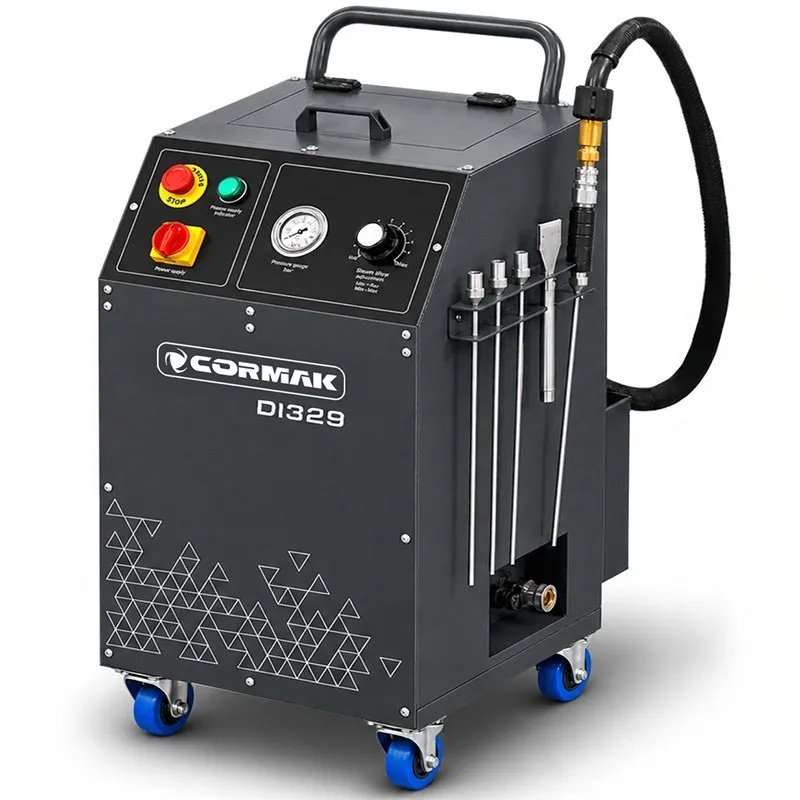
The range of CORMAK dry ice cleaning machines can be compared in terms of pressure regulation, compressed air demand, available nozzles and mobility. One example is the CORMAK DI325 dry ice cleaning machine, designed for industrial and servicing applications. Electrical power consumption alone does not fully describe cleaning capabilities.
Dry ice versus abrasive blasting and laser cleaning
Sandblasting and other abrasive blasting methods are suitable for removing strongly adherent corrosion and coatings. A correctly selected abrasive can also produce the surface profile required for particular protective coating systems. Such work may involve sandblasting and surface cleaning equipment. Spent blasting media and the removed contaminants must then be collected and handled appropriately.
Dry ice is an attractive alternative when cleaning must not leave behind additional abrasive material. It can remove grease, deposits and loose rust, but does not automatically replace the preparation of steel prior to painting. A visually clean surface may not meet the required cleanliness or roughness specifications.
Another option is laser cleaning equipment for rust removal. With suitable process parameters, lasers can remove local corrosion and coating layers. However, they require beam access to the target, appropriate settings, a controlled working area and extraction of smoke and airborne particles. Laser cleaning is not automatically suitable for every crevice or material.
The choice between dry ice, abrasive blasting and laser cleaning depends on the substrate, the adhesion of the deposits, the required finish and the working conditions. In many factories, these technologies complement one another rather than serving as complete substitutes.
When should dry ice cleaning be used?
The technique is worth considering for regular cleaning of machines, moulds and assemblies when dismantling and downtime are costly. The lack of spent blasting media may simplify clean-up, but overall working time still includes preparation, protection of surrounding equipment and collection of dislodged material.
Before starting, assess the substrate, the type of contamination and the required final condition. The availability of fresh pellets, compressor delivery capacity and compressed air quality are also important. Working pressure, pellet feed, nozzle and stand-off distance should be selected through trials rather than solely from the machine's maximum specifications.
Cost comparisons should include pellets, compressed air, transport and labour. Frequency of use, workplace conditions and the required cleaning result also matter, not just the machine's purchase price.
Safety and workplace preparation
Sublimation releases gaseous CO₂, which can accumulate to dangerous concentrations. A risk assessment, effective ventilation and appropriate concentration monitoring are necessary, particularly in enclosed or poorly ventilated areas. An ordinary dust mask does not protect against elevated carbon dioxide levels.
Cold-protective gloves are required when handling dry ice pellets. During blasting, operators also need suitable eye and hearing protection and protective clothing. Exposure to dislodged substances must be controlled. When dealing with electrical components, the absence of added water does not remove the need for electrical isolation, assessment of possible moisture condensation and appropriate inspection before restarting equipment.
Summary
Removing rust with dry ice can be useful for loose corrosion deposits, oils, grease and industrial residues. The process leaves no spent cleaning pellets, but cannot guarantee removal of strongly adherent rust or pitting corrosion.
Abrasive blasting remains important for surface preparation, while lasers provide controlled cleaning in suitable applications. The best method should be selected through testing, assessment of the required final condition and evaluation of workplace risks. Proper equipment selection can improve industrial maintenance without overestimating what dry ice cleaning can achieve.
