


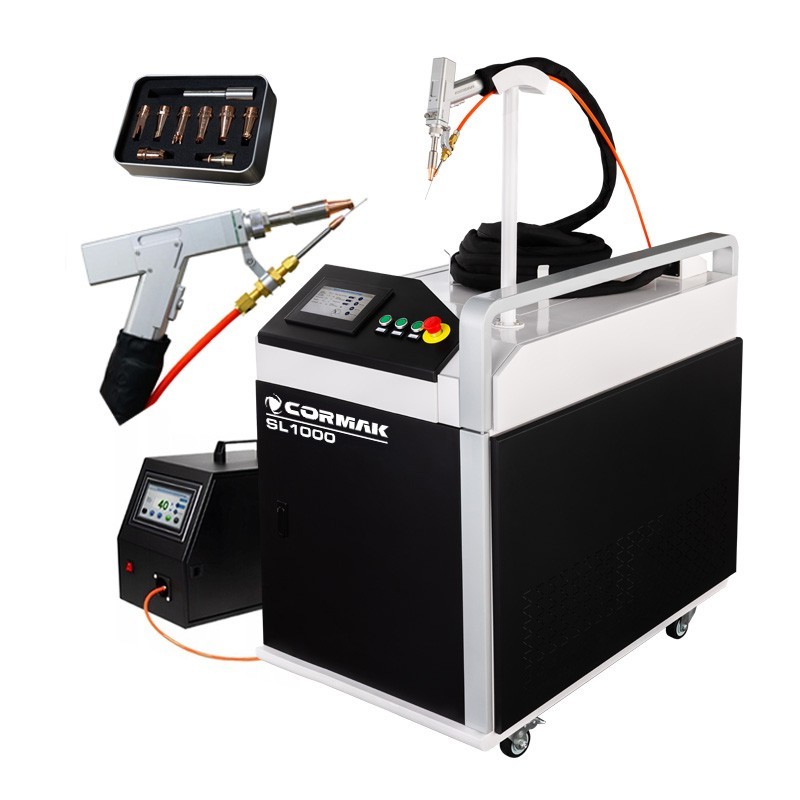
A 3-in-1 laser welder combines welding with laser cleaning and supplementary metal cutting. Learn how the system works, when a wire feeder expands its capabilities and where a multifunction machine can reduce the number of separate workstations. Find out when a dedicated laser cleaner or CNC laser cutter remains the better choice.
3-in-1 laser welder – welding, cleaning and cutting in one machine?
A 3-in-1 laser welder combines welding, laser cleaning and supplementary metal cutting within one system. This can reduce the number of separate machines required at a workstation and increase flexibility, particularly in workshops and production facilities handling varied jobs.
The primary function remains laser welding. A concentrated beam delivers energy locally to the joint and, with suitable parameters, can produce a narrow weld with a limited heat-affected zone. Cleaning and cutting modes broaden the machine's capabilities, but do not replace specialist equipment in every application.
How does a 3-in-1 laser welder work?
The machine uses a FIBER laser source and a handheld working head. Depending on the selected mode, process settings change and, depending on the machine design, so may the nozzle, optics or head configuration.
A CORMAK laser welding machine in a 3-in-1 configuration can be used for:
- welding metal components,
- cleaning surfaces and areas around welds,
- removing selected discolouration and deposits,
- supplementary cutting of thin components,
- preparing material for subsequent processing.
Changing the function is not simply a matter of selecting another program. The configuration specified by the manufacturer must be used and the settings matched to the material and operation.
Laser welding – the primary function
The main task is joining metal components with a concentrated laser beam. Compared with many traditional processes, welding can be fast and introduce less heat into the area surrounding the joint, which can be particularly useful for thin parts prone to distortion.
A 3-in-1 laser welder can, with suitable parameters, shielding gas and filler material where required, work with stainless steel, structural steel and aluminium. A single set of settings is not suitable for every material and thickness.
The technology is used for enclosures, cabinets, metal furniture, railings, tanks and stainless-steel components. Accurate edge preparation and good fit-up remain important for repeatable results.
Laser cleaning after welding
The second function is laser cleaning. A correctly configured beam can remove selected deposits, heat discolouration and contamination from a surface or the area immediately around a weld.
This may reduce the need to move a component to another workstation or carry out certain additional mechanical finishing operations. The benefit can be particularly useful in one-off work and short production runs.
The cleaning mode of a multifunction system does not replace a dedicated laser cleaning machine in every application. Where the primary task is daily removal of rust, paint or coatings from large surfaces, a specialist cleaner can provide greater productivity and a process range designed specifically for cleaning.
Can a 3-in-1 laser welder really cut?
Yes, where the specific machine has been designed and equipped by the manufacturer for that operating mode. The function should, however, be regarded as supplementary rather than an equivalent to an industrial CNC laser cutting machine.
A handheld head can make simple cuts, small corrections and trimming operations within the specified working range. Material type and thickness must remain within the machine's technical specification.
A 3-in-1 laser welder does not replace a FIBER CNC laser cutter with a cutting table, numerical control, dedicated cutting head and programmed toolpath. For series production of accurate shapes from sheet, equipment in the laser and plasma technology range is the appropriate solution.
Why can one machine speed up the workflow?
The main benefit of the 3-in-1 concept is fewer workstation changes. An operator can prepare a selected area, make the weld and then clean the joint area without moving the component between several large machines.
This can reduce non-productive time associated with transporting components, switching equipment and setting up another workstation. The benefit is particularly relevant in one-off, short-run and medium-batch production.
Changing modes is not necessarily instantaneous. Depending on the model, settings, nozzles or other head components may need to be changed before work resumes.
3-in-1 laser welder with wire feeder
Not every joint should be made without filler material. Where gaps, particular joint geometries or process requirements call for additional material, an automatic wire feeder can be useful.
The wire is fed into the welding zone in a controlled manner, helping to fill the joint and maintain process consistency. Wire material and diameter need to suit the base material and procedure.
A wire feeder does not remove the need for correct preparation. Fit-up, surface cleanliness, joint gap and secure fixturing continue to affect weld quality.
When is a 3-in-1 laser welder worth considering?
A multifunction system is particularly interesting for businesses carrying out varied work and looking to make one workstation more flexible. Applications include enclosures, stainless structures, tanks, railings, metal furniture and components manufactured from thin and medium-gauge sheet.
The system can also be attractive where workshop space is limited and supplementary cleaning and cutting are genuinely useful parts of the workflow. One machine can then take over some tasks previously spread across several stations.
The dominant process should be identified before purchasing. Where most machine time is spent welding and cleaning and cutting are supplementary operations, the 3-in-1 concept can be especially logical.
Is 3-in-1 always the best solution?
No. Multifunctionality involves compromises. If a company cleans large surfaces every day, a dedicated laser cleaner may provide better productivity. If complex sheet components are cut automatically in series, a CNC laser cutting machine is clearly more appropriate.
A facility almost entirely focused on one operation may also benefit more from equipment optimised for that task. The main strength of a 3-in-1 system is versatility, not the complete replacement of every specialist machine.
Laser safety
Handheld laser welding systems use high-power laser sources. They require a properly controlled laser area, protection from both direct and reflected beams, protective measures appropriate to the laser wavelength and procedures preventing unauthorised access.
Welding, cleaning and cutting can also generate fumes, dust and aerosols depending on the base material and coatings. Appropriate ventilation and extraction are therefore required. Personal protective equipment is not a substitute for engineering controls.
The operator should be trained for the particular machine and should use only the configurations permitted by its documentation. This also applies when switching between welding, cleaning and cutting modes.
Summary
A 3-in-1 laser welder can combine welding, cleaning and supplementary metal cutting at one workstation. Laser welding remains the primary function, while the other modes increase flexibility.
The cleaning function can simplify selected preparation and finishing operations, while cutting can help with simple handheld corrections. For high-throughput surface cleaning or automated cutting of complex shapes, specialist machines remain the better solution.
For businesses carrying out varied work, a CORMAK 3-in-1 laser welder can expand the capabilities of a single workstation. Selection should nevertheless reflect the actual process mix, materials, quality requirements and a properly designed laser-safety system.
