


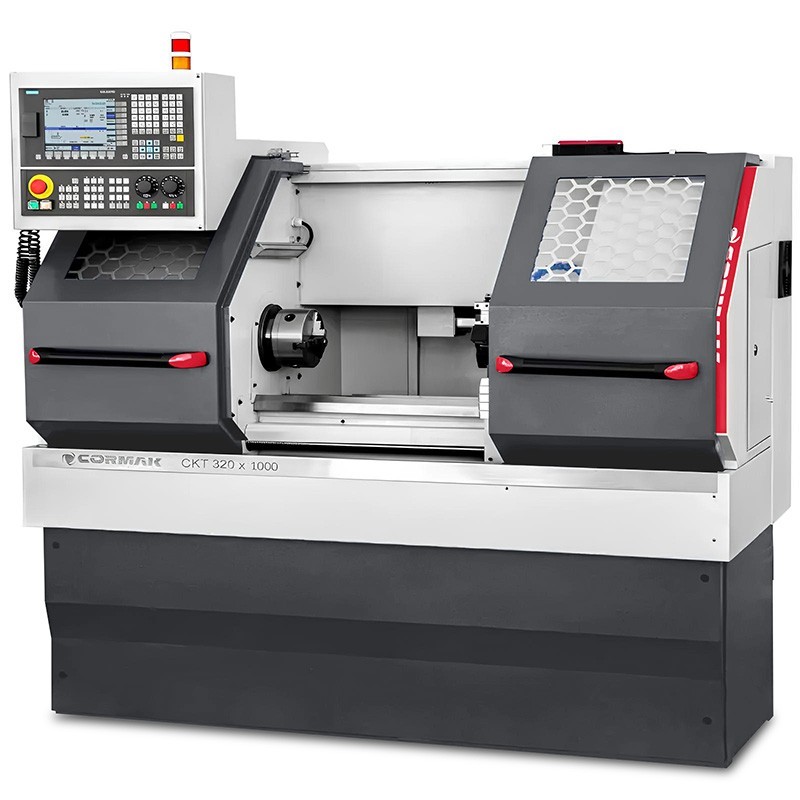
Conventional lathe or CNC? The right choice depends on the parts being produced, batch size, required repeatability and the way production is organised. Learn when a manual lathe can be faster and more economical and when CNC automation provides a genuine advantage. Explore the key machine specifications and cost factors to consider before investing.
Conventional lathe or CNC lathe – which should you choose?
The choice between a conventional lathe and a CNC lathe should primarily reflect the type of components being produced, batch size, frequency of production changes and required productivity. Both machine rotating components, but differ in control method, automation, setup time and production capability.
A conventional lathe is particularly useful for repairs, refurbishment, one-off components, prototypes and short runs. CNC lathes provide greater automation and repeatability and, with a properly prepared process, can achieve much higher productivity in series production.
How does a conventional lathe work?
On a conventional lathe, the operator directly controls most machining activities. The tool is set manually, spindle speed and feed are selected, individual cuts are performed and dimensions are checked throughout the job.
This provides considerable flexibility. A single bush, shaft, axle, pin or repair component can be set up quickly. For a simple one-off part, starting the job may take less time than programming, tooling and establishing work offsets on a CNC machine.
Conventional lathes work well in repair shops, maintenance departments, toolrooms, training environments and companies handling varied jobs.
Accurate work still requires skill. Cutting data, tool height, runout, workholding and regular measurement all need to be controlled correctly.
When should you choose a conventional lathe?
A conventional lathe is particularly practical when repairs, prototypes, one-offs and frequently changing short runs dominate the workload.
An experienced turner can quickly alter the operation sequence, make dimensional corrections and respond to unusual component conditions without preparing a complete program.
When selecting the machine, look beyond swing over bed. Distance between centres or usable turning length, swing over cross slide, spindle bore, spindle nose, motor power and speed and feed ranges all matter.
The limitation is greater dependence on the operator. As the quantity of identical parts increases, manual operations take a larger share of production time and part-to-part variation becomes more difficult to control.
What does a CNC lathe offer?
A CNC lathe performs axis movements and machining operations according to a program. The operator or process engineer defines tooling, work offsets, cutting data and operation sequence before the control executes the cycle.
Numerically controlled lathes can perform external and internal turning, facing, grooving, drilling, threading and parting. Driven tools and additional axes on more advanced machines can add further operations.
The major advantage is the ability to reproduce a prepared process. Once the machine, tools and offsets have been set correctly, subsequent components follow the same programmed movement sequence.
CNC does not eliminate the need for process control. Tool wear, material variation, temperature, workholding and incorrect offsets can all still affect component quality.
CNC lathes and production efficiency
In series production, a CNC lathe can reduce unit cycle time because tool movements are repeated automatically rather than reproduced manually for every component.
The program can also be optimised by reducing non-cutting movement, using suitable machining cycles, improving tool selection and reducing the number of setups. The initial programming effort is then spread across many parts.
Hydraulic chucks, bar feeders, automatic tailstocks, chip conveyors and driven tooling can reduce manual involvement still further. CORMAK's wider lathe range includes machines with substantially different levels of automation.
For a single simple part, the opposite may be true. If programming and setup take longer than the machining operation itself, a conventional lathe can complete the job more quickly. The CNC advantage increases as batch size and process complexity rise.
Accuracy and repeatability – CNC or conventional?
An experienced operator can achieve highly accurate results on a conventional lathe as well. CNC control does not automatically make every individual component more accurate.
The difference becomes particularly important when the same process is repeated. Programmed axis movements make it easier to reproduce positions and machining sequences on subsequent parts. Tool offsets can also be adjusted as cutting edges wear.
On a manual lathe, passes and corrections are reproduced by the operator. This may be entirely practical for one component, but in a large batch it increases measurement and operator time.
On both types of machine, accuracy also depends on structural rigidity, guideway and spindle condition, chuck quality, tooling, workpiece support and thermal conditions.
Which lathe should you choose for a workshop?
If a workshop mainly handles repairs, refurbishment, prototypes and one-off parts, a conventional lathe is usually a practical and economical choice. It provides direct access to the machining process and considerable flexibility.
If the business plans to expand repetitive production and automation, a CNC lathe provides significantly greater capability. It is also useful when parts require numerous repeatable operations in a strictly defined sequence.
Many businesses benefit from having both technologies. A conventional machine can handle urgent repairs and unusual parts, while CNC carries out planned repeat production.
Before investing, analyse actual recent work: typical batch sizes, frequency of part changes, tolerances and time spent setting up machines.
Which specifications matter?
The control type alone is not enough to select a machine. Two lathes in the same category can have very different working envelopes.
Important specifications include:
- swing over bed,
- swing over cross slide,
- distance between centres or usable turning length,
- spindle bore,
- chuck type and size,
- spindle speed range,
- spindle motor power and characteristics,
- feed range or axis speeds,
- structural rigidity and machine weight,
- tailstock and workholding arrangement,
- number of tools and optional equipment.
For CNC, also compare the control system, number of axes, turret configuration, driven tooling and automation options. For conventional machines, operator ergonomics, gearbox design, threading ranges and digital readout availability may be important.
Purchase cost and production economics
A CNC lathe generally represents a larger initial investment than a comparable conventional machine. Purchase price should not, however, be the only criterion. In series production, cost per component, operator time, setup, quality control and machine utilisation are more informative.
CNC may require process preparation, training, appropriate tooling, control-system servicing and, in some applications, CAD/CAM software. In return, automation can substantially reduce the amount of direct manual operator involvement required for each component.
A conventional lathe may require less initial capital, but a larger proportion of process value is provided by a skilled operator. This is often an advantage in one-off work but can become a productivity constraint in high-volume production.
The most useful comparison is the total cost of producing the parts that are typical for the business.
Summary
The choice between conventional and CNC turning should reflect the production profile. For one-off components, repairs, prototypes and frequent job changes, a conventional lathe provides considerable flexibility and may have a shorter setup time.
For larger batches, high repeatability requirements and increasing automation, CNC lathes offer clear advantages. Their value increases as the number of repeat parts grows and additional automation is used.
Before purchasing, also compare turning diameters, working length, spindle bore, speed range, power, rigidity and equipment. Matching those specifications to the actual mix of work is what determines whether the selected lathe will be productive and economically justified.
