


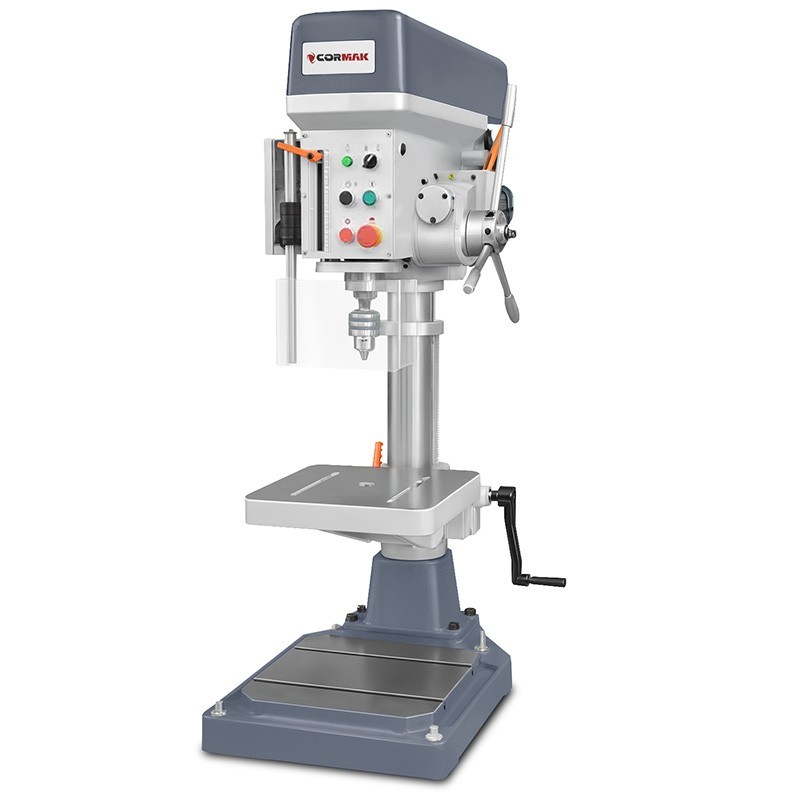
A hand-feed drill works well for individual holes, repair work and small batches. The operator controls the pressure on the tool and the rate at which it penetrates the material. However, in high-volume production and when drilling many similar holes, this approach can limit productivity.
Drill press with automatic feed – when is it worth paying extra?
A manually fed drilling machine works well for individual holes, repairs, prototypes and small batches. The operator directly controls tool penetration and can quickly react to changes in material, drill diameter and cutting behaviour.
In intensive production involving many similar holes, manual spindle feed can limit productivity and increase operator workload. In these conditions, a drill press with automatic feed is worth considering, because the working movement of the spindle is performed mechanically at a selected feed rate.
Automatic feed does not mean fully automatic machining. The operator remains responsible for workholding, tool selection, spindle speed, coolant, feed settings and process supervision.
How does automatic feed work?
On a conventional drill press, the spindle is lowered manually using a feed handle. On a machine with automatic feed, the working stroke is driven mechanically according to the selected feed setting.
Depending on the machine design, the operator may choose from several feed rates. This allows the feed to be matched to drill diameter, material, hole depth, spindle speed and the required machining quality.
On industrial drilling machines, feed is often specified in mm/rev, representing the distance travelled by the tool during one spindle revolution.
CORMAK's pillar drill range includes machines with automatic feed and cooling systems for more demanding production work.
When does automatic feed increase productivity?
The greatest benefit appears in series production. Where dozens or hundreds of similar holes are produced, a repeatable spindle movement reduces the amount of manual feeding required.
Automatic feed is particularly useful for:
- repetitive drilling operations,
- thicker steel components,
- larger drill diameters,
- deeper holes,
- intensive production work,
- processes requiring repeatable feed settings.
Automatic feed does not necessarily reduce the pure cutting time. If spindle speed and feed are the same, the physical drilling time may be similar. The advantages lie mainly in consistency, ergonomics and cycle organisation.
A genuine productivity improvement occurs when automatic feed is incorporated into a well-organised process with reliable workholding and repeatable positioning.
Better drilling repeatability
With manual feed, the penetration rate depends on the operator. It may change with fatigue, experience and the behaviour of the material.
Excessive feed can overload the drill and spindle, while insufficient feed can cause unnecessary rubbing, heat generation and longer cycles.
Automatic feed helps maintain a more consistent feed rate. With the other parameters correctly selected, successive holes can be produced under more similar cutting conditions.
Hole quality still depends on tool condition, runout, workholding rigidity, chip evacuation, coolant and material properties. Automatic feed is one component of a stable process, not the only factor.
Automatic feed with larger drill diameters
As drill diameter increases, torque and cutting forces generally increase as well. With manual drilling, the operator must maintain the appropriate movement through the feed handle throughout the operation.
Automatic feed takes over this movement and advances the tool at a selected constant value. This can be particularly useful in thicker materials and longer drilling cycles.
The feed function does not, however, increase maximum drilling capacity on its own. Capacity also depends on motor power and torque, column rigidity, transmission, spindle taper, toolholding and the overall design of the drilling machine.
Correct spindle speed is equally important with large diameters. Excessive speed can rapidly overheat and wear the cutting edge.
Reduced operator workload
During repetitive drilling, an operator may perform hundreds of similar movements with the feed lever. Automatic feed reduces this repetitive action and can improve workstation ergonomics.
The operator still needs to load and clamp components, inspect tools, manage chips safely, monitor coolant and supervise the process. Automatic feed does not mean that the drill press should be left unattended.
The benefit can be particularly noticeable where parts are positioned using fixtures, vices or stops and the workstation repeats similar cycles.
Across a long shift, reducing manual feed movements can help maintain a more consistent working pace.
When is manual feed sufficient?
Not every workshop needs automatic feed. Manual feed is often entirely sufficient for repair work, prototypes, individual holes and small batches.
If material, component geometry, drill diameter and hole depth change frequently, direct manual control can be convenient. The operator can immediately respond to the cutting conditions.
For occasional drilling or very short cycles, the extra machine cost may not be economically justified.
Before purchasing, analyse the actual number of holes produced per day and the proportion of working time spent drilling.
What should you look for before buying?
When comparing machines in the CORMAK drilling machine range, do not consider automatic feed in isolation.
Important specifications include:
- maximum drilling diameter,
- available automatic feed rates,
- spindle stroke,
- spindle taper,
- spindle speed range,
- motor power,
- column diameter and rigidity,
- worktable dimensions and capacity,
- spindle-to-table and spindle-to-base distances,
- the ability to clamp the workpiece securely.
Cooling system
For intensive drilling, a coolant system can be useful. Appropriate cutting fluid helps control temperature, supports chip evacuation and can improve tool life.
The coolant type and application method need to suit the workpiece material, cutting tool and operation.
Workholding
Automatic feed makes secure workholding especially important. The component must not be held by hand. It should be secured in a vice, fixture or directly to the table using appropriate clamps.
Once the automatic feed cycle is engaged, the operator should not attempt to reposition the component manually.
When does the extra cost pay off?
The additional cost is most easily justified where the drill press performs many similar operations every day. The more frequently automatic feed is used, the greater the significance of reduced manual effort and more consistent feed settings.
It is useful to calculate how much time the operator spends manually feeding the spindle during a typical shift.
The analysis should also include workpiece loading, clamping, depth setting, tool changes, chip removal, measurement and inspection. Automatic feed does not shorten process stages that remain manual.
It therefore offers the best economic return where the process is standardised and the spindle feed is a repetitive element of each cycle.
Summary
A drill press with automatic feed is particularly useful for intensive and repetitive drilling. It helps maintain a more consistent feed rate, reduces manual spindle movement and improves ergonomics during long periods of work.
For individual holes, repairs and highly varied tasks, manual feed is often entirely sufficient. The value of automatic feed increases as the number of repeated cycles rises.
Before purchasing, compare not only the feed method but also drilling capacity, spindle stroke and taper, speed range, power, cooling, structural rigidity and workholding. Only the complete specification reveals whether the extra investment will actually improve workshop productivity.
