


Rounding edges after laser cutting improves safety, coating quality and production consistency. Learn why manual deburring can become a bottleneck as volumes increase and how an automatic deburring machine can remove burrs and produce more repeatable edge finishing on laser-cut sheet-metal components.
Rounding edges after laser cutting with a deburring machine
Laser cutting is a highly precise method of processing sheet metal and other metal components. It provides repeatable contours and does not require mechanical contact between a cutting tool and the workpiece.
Even so, burrs, resolidified material and sharp edges can remain after the cutting process. Their extent depends on the material, thickness, process gas, cutting parameters, nozzle condition and general process setup.
This is why many production facilities include deburring and edge rounding as a separate finishing stage.
Consequences of sharp edges
Burrs and sharp edges are not simply cosmetic defects. They can affect operator safety, downstream processing and final product quality.
Operator safety
Sharp sheet-metal edges increase the risk of cuts during handling, sorting, welding and assembly. Rounding those edges can reduce the hazard, although appropriate gloves and safe handling procedures remain necessary.
Coatings and joining
An extremely sharp edge can be more difficult to cover evenly with powder coat, paint or other protective finishes. Burrs can also interfere with accurate part fit-up before welding or assembly.
Assembly and final appearance
Untreated edges can damage seals, wiring, insulation and adjacent surfaces. Edge quality can also have a direct effect on the perceived quality of finished products.
Why does manual deburring become uneconomical?
For small quantities, a file or handheld grinder can be sufficient. As production rises to hundreds or thousands of parts, manual deburring can consume a substantial number of labour hours.
Consistency also becomes more difficult. Different operators may use different pressure, angles and processing times, producing different edge radii and surface conditions.
At higher volumes, an automated solution within a wider range of metal grinding and finishing machines can be easier to integrate into production.
How does an automatic deburring machine work?
An automatic deburring machine transports the workpiece through a processing zone containing abrasive belts, brushes, rotors or a combination of these systems.
Abrasive units can remove larger burrs while rotating brushes or planetary heads act on the edges from different directions.
Feed speed, working height and abrasive-unit settings can be repeated for subsequent batches, which is a major advantage over manual processing.
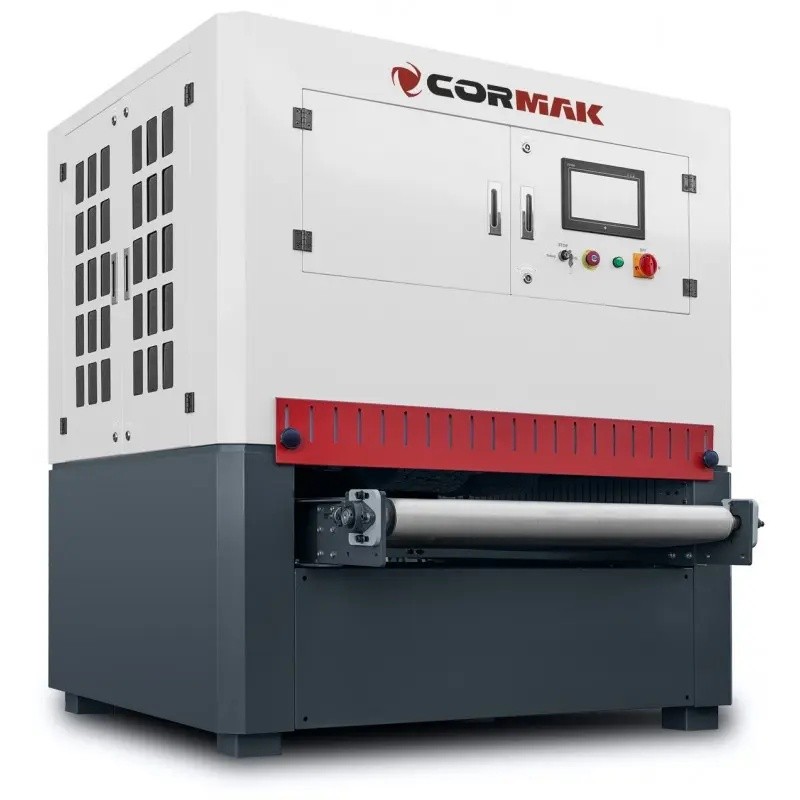
CORMAK SG1000
The CORMAK SG1000 is designed for deburring and edge rounding, including components produced by laser cutting.
Its working width is 1000 mm and it can process material from 1 to 70 mm thick. Four independently driven abrasive units work on components as they travel through the machine.
Feed speed can be adjusted so that the process intensity can be matched to the workpiece and required result. Additional passes can be used where required.
The machine should not be viewed as a substitute for correctly optimised laser cutting. Excessive dross caused by an unsuitable cutting process may need another operation first.
Edge rounding and coatings
A rounded edge creates a more favourable geometry for many coating processes than an extremely sharp corner.
The required radius should, however, be defined by the product specification and finishing process rather than by machine capability alone.
Where further surface finishing is required, CORMAK also offers a wider range of metalworking machines.
When should deburring be automated?
Automation becomes particularly attractive when large quantities of similar laser-cut components are processed every day and manual deburring becomes a production bottleneck.
Before investing, calculate labour hours, abrasive consumption, rework, component dimensions and the throughput of the laser-cutting department.
If deburring forms part of a wider investment in sheet-metal processing, it is also worth reviewing CORMAK's industrial machinery range and laser and metalworking technologies.
Summary
Rounding edges after laser cutting improves handling safety, supports downstream processes and creates more repeatable component finishing.
For low quantities, manual work may be sufficient. As production volumes rise, automatic deburring can reduce labour input and stabilise edge quality across the batch.
A machine such as the CORMAK SG1000 can incorporate deburring and edge rounding into a continuous production flow. Machine selection should always reflect actual workpiece dimensions, materials, finish requirements and required throughput.
