


Strapping or stretch wrap? Learn which method works for light, heavy and irregular pallet loads and when combining PP/PET strapping with stretch film makes sense.
Strapping or stretch wrap – how should you secure a pallet?
Correct pallet load securing is important during storage, handling and transport. Goods should remain as stable as possible during forklift movements, braking, cornering and travel over uneven surfaces.
Two common methods are strapping and stretch wrapping. CORMAK offers a range of handling and warehouse equipment for professional logistics processes.
How does pallet strapping work?
Strapping involves passing a strap around a package or pallet load, tensioning it and joining the ends. PP and PET are two commonly used plastic strapping materials.
PP is typically suited to cartons and lighter or medium-duty loads. PET provides greater strength for more demanding palletised products.
Where strapping is carried out regularly, strapping machines can reduce manual operations and improve process repeatability.
How does stretch wrap work?
Stretch film is applied under tension around the pallet load. Multiple layers help hold cartons and individual packages together as one transport unit.
The lower wrapping passes should connect the load to the pallet itself rather than only wrapping the cartons.
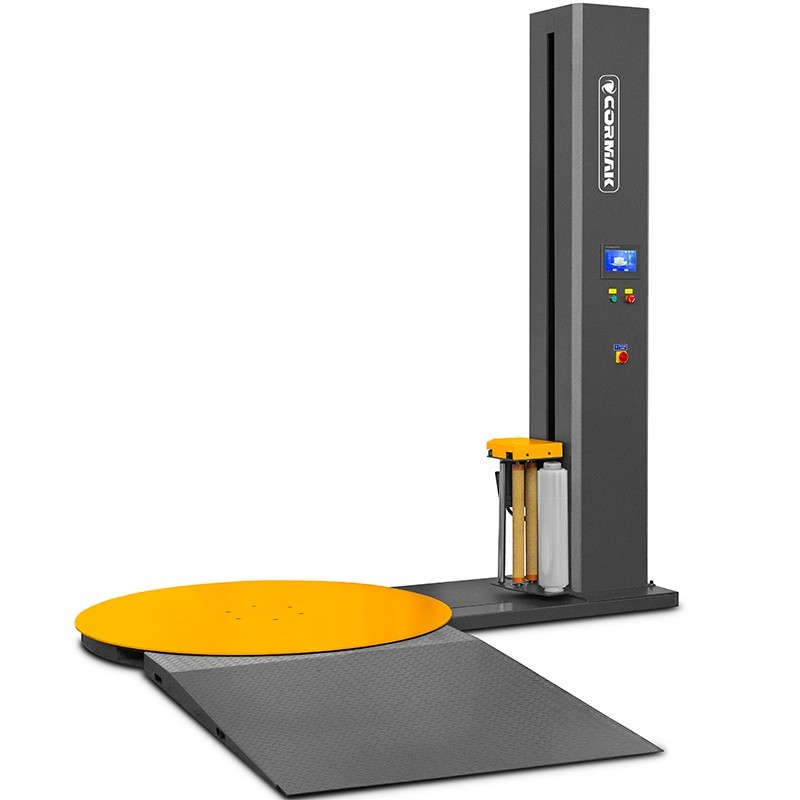
For larger packaging volumes, pallet wrapping machines provide more repeatable wrapping cycles than purely manual work.
Strapping or stretch wrap for heavy loads?
Heavy products often require strong mechanical restraint. PET strapping can provide significant tension and help keep industrial goods positioned on the pallet.
Stretch wrap alone may not be sufficient for very heavy, compact or irregularly shaped items. In these cases, the strap can provide mechanical stabilisation while the film keeps smaller packages grouped together.
When is stretch wrap enough?
Stretch wrap can be a practical solution for lightweight and medium-weight cartons that are evenly stacked and already geometrically stable.
Film quality, pre-stretch, wrapping pattern and the number of revolutions all affect the result.
Why use corner protectors?
Strapping concentrates force along a relatively narrow line. Corner protectors distribute that pressure over a larger surface and help prevent crushed cartons or damaged edges.
They are particularly useful with fragile packaging and products with sharp corners.
When should you combine both methods?
High, heavy, valuable or frequently handled pallet loads may benefit from both methods. Strapping provides mechanical restraint while stretch film groups the load and protects its surface from dirt.
How can pallet packaging be automated?
Automating strapping
Battery-powered, semi-automatic and automatic strapping equipment can reduce manual tensioning and joining operations.
Automating stretch wrapping
A pallet wrapper can apply a defined wrapping cycle more consistently, which becomes particularly useful in production plants and distribution centres handling many pallets each day.
How do you choose the right method?
Consider:
- load weight,
- pallet height,
- product shape,
- packaging type,
- susceptibility to damage,
- transport distance,
- number of handling operations,
- daily packaging volume.
Neither method should be selected on the basis of pallet weight alone. The complete load configuration and expected transport conditions need to be considered.
Summary
Strapping and stretch film perform different but complementary functions. Strapping provides concentrated mechanical restraint, while stretch wrap holds individual packages together and protects the outside of the load.
For demanding pallet loads, using both methods together with suitable corner protection can provide a more complete packaging solution.
