


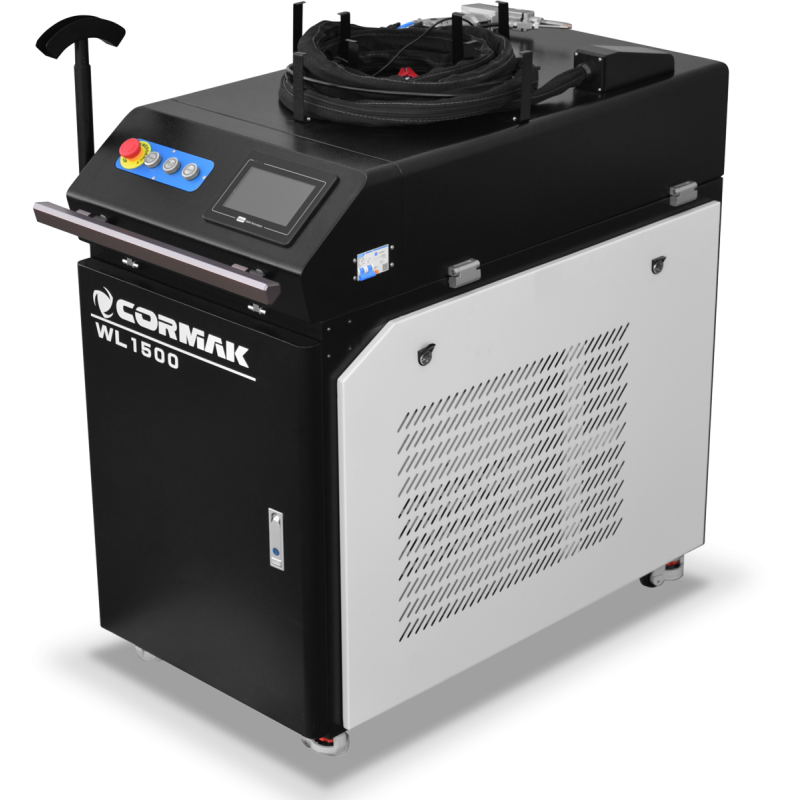
Laser welder or MIG/MAG welder – which technology is right for your business? We compare welding speed, weld quality, distortion, joint preparation and production costs. Discover when investing in handheld laser welding can improve efficiency and when conventional MIG/MAG welding remains the more practical and cost-effective solution.
Laser Welder vs MIG/MAG – Which Should You Choose?
MIG/MAG welding has been one of the most widely used methods of joining metals in workshops and industrial production facilities for many years. The technology is versatile, familiar to operators and relatively tolerant of imperfectly fitted components. However, more businesses are considering handheld laser welding machines, which can increase welding speed, reduce distortion and minimise the amount of finishing work required after welding.
Choosing the right machine involves considering material type, component thickness, production batch size, quality requirements and the overall cost of producing each joint. It is therefore worth exploring the capabilities of CORMAK laser welding machines and comparing them with conventional MIG/MAG equipment.
How does MIG/MAG welding work?
MIG/MAG welding uses an electric arc generated between the base material and a continuously fed wire electrode. The consumable electrode supplies filler metal to form the weld, while shielding gas protects the molten weld pool from the surrounding atmosphere.
MIG welding uses an inert shielding gas, usually argon or a suitable gas mixture, and is commonly used for aluminium. MAG welding uses active shielding gases or appropriate gas mixtures and is widely employed when welding structural steels.
MIG/MAG works well for heavier structures, repairs and components with varying geometries. However, the process requires careful control of welding parameters, torch angle and travel speed. Incorrect settings can result in spatter, uneven welds, excessive weld reinforcement and greater thermal distortion.
Why can laser welding be more productive?
A laser welding machine uses a highly focused light beam with high energy density. This allows the edges of the material to melt rapidly and form a narrow weld while limiting the heating of surrounding areas.
The smaller heat-affected zone helps reduce warping in thin sheet metal, twisting of structures and dimensional changes. These benefits are particularly important when manufacturing enclosures, electrical cabinets, tanks, metal furniture and decorative components.
With appropriately prepared joints, laser welding can often achieve a higher travel speed than MIG/MAG. In batch production, reducing the time required for each weld can increase the number of finished components produced per shift. Actual productivity still depends on material thickness, joint geometry and machine settings.
Laser welding vs MIG/MAG: comparison table
| Criterion | Laser welding | MIG/MAG |
|---|---|---|
| Welding speed | Potentially higher with accurately prepared joints | Versatile, dependent on parameters and number of passes |
| Heat-affected zone | Generally narrower | Generally wider |
| Weld appearance | Narrow and consistent, often with minimal reinforcement | Usually wider, with possible spatter |
| Gap tolerance | Requires more accurate component fit-up | Better tolerance of larger gaps |
| Finishing requirements | Often reduced | Cleaning and grinding more frequently required |
| Initial investment | Generally higher | Generally lower |
| Typical applications | Batch production, thin sheet metal, visible components | Structural work, repairs and installation |
This comparison illustrates typical characteristics of the two processes. Actual results depend on the specific machine, material, joint preparation and operator competence.
Weld quality and finishing requirements
One important advantage of laser welding is the ability to produce narrow, uniform and visually attractive welds. Correctly selected parameters help minimise spatter, excessive weld reinforcement and the need for intensive grinding.
With MIG/MAG, additional work may be needed to remove spatter, level the weld surface and prepare components for painting or coating. This adds labour time, consumes abrasives and increases production costs.
When manufacturing railings, metal furniture, tanks, enclosures and stainless steel components, reducing finishing operations can significantly improve process economics. However, an attractive weld does not automatically guarantee adequate penetration or mechanical strength. Joints subject to specific quality requirements must be inspected in accordance with the relevant technical documentation.
Preparing components for welding
Laser welding requires clean, even and accurately fitted joint edges. Oil, paint, moisture, rust, mill scale and other contaminants should be removed before welding begins. Securely clamping and positioning the components is equally important.
In certain applications, a wire feeder can supply filler material and compensate for small joint gaps. Nevertheless, it cannot replace proper joint preparation. When workpieces need to be rotated or positioned accurately, CORMAK welding positioners can help improve stability and process repeatability.
MIG/MAG is more tolerant of imperfect fit-up and larger gaps between components, although suitable cleaning is still necessary. This makes it a practical option for repairs, on-site work and structural assembly.
Materials and welding thicknesses
Both technologies can be used to join structural steel, stainless steel and aluminium, provided the equipment, shielding gas and process settings are properly selected.
Laser welding is particularly attractive for thin and medium-thickness sheet metal, where reducing heat input helps preserve component geometry. When welding aluminium, its high thermal conductivity, surface characteristics and the risk of laser beam reflection must be considered.
For thick structural components, large joint gaps and welds requiring multiple filling passes, MIG/MAG can be more flexible. The maximum thickness suitable for laser welding cannot be determined from laser power alone. Material properties, joint geometry and required penetration also matter.
Welding costs and return on investment
Purchasing a laser welding machine generally involves a higher initial investment than buying a conventional MIG/MAG welder. However, evaluating cost-effectiveness requires looking at the entire production process rather than considering only the machine price or the time spent making the weld.
The calculation should include electricity, wire and shielding gases, component preparation, grinding, rework, maintenance, operator training and essential workplace safety measures. If laser welding reduces the duration of several production stages, the higher purchase price may be offset by a lower cost per finished component.
The most reliable way to assess the return on investment is to conduct practical welding trials on real components and measure the complete manufacturing time, including quality inspection.
Welding safety
High-power handheld laser welders are generally Class 4 laser products. Both direct and reflected beams can cause serious injuries to the eyes and skin. Wearing safety glasses alone is therefore not sufficient to make the process safe.
The workstation requires a risk assessment, suitable shielding or a controlled laser area, access controls, protective equipment appropriate to the laser wavelength and properly trained personnel. Effective welding fume extraction, ventilation and fire precautions are also essential.
MIG/MAG welding also involves hazards associated with arc radiation, spatter, hot surfaces, welding fumes and electricity. With either process, establishing a safe working environment is an integral part of the investment.
When should you choose a laser welder?
Laser welding can be particularly beneficial for businesses that:
- manufacture regular, repeatable production batches,
- work mainly with thin and medium-thickness sheet metal,
- weld structural steel, stainless steel or aluminium,
- want to reduce heat-related distortion,
- incur high grinding and rework costs,
- need to increase workstation throughput,
- require attractive welds on visible components.
For repeatable components and well-organised processes, a handheld laser welder can improve productivity and production consistency. Practical trials with representative materials are recommended before investing.
When is MIG/MAG the better option?
MIG/MAG remains a practical choice for workshops handling varied one-off jobs, repairs, assembly work and heavier steel structures. It is particularly useful when components have changing geometries or precise joint fit-up cannot always be guaranteed.
Lower initial costs and the widespread availability of consumables can be decisive for smaller businesses. In one-off manufacturing, a conventional MIG/MAG welder may remain more economical even when completing the weld itself takes longer.
Conclusion
There is no single welding process that is best for every application. MIG/MAG offers versatility, flexibility and greater tolerance of imperfectly prepared joints. Laser welding, on the other hand, can provide faster operation, reduced distortion and less finishing work.
For businesses producing regular batches, a suitable laser welding system is worth considering. One example is the CORMAK WL3000 3-in-1 laser welding machine. Before purchasing, compare production requirements, equipment capabilities, workplace safety costs and the results of practical welding trials.
