


Effective removal of sawdust, wood shavings and wood dust improves the quality of work, extends the service life of machinery and keeps the workshop tidy. When choosing an extraction system for a joinery workshop, people most often compare a cyclone system with a conventional industrial extraction system fitted with bags, containers or filters.
Effective removal of sawdust, shavings and wood dust affects the quality of work, the service life of machinery and the tidiness of the workshop. When choosing an extraction system for a joinery workshop, people most often compare a cyclonic system with a traditional industrial extraction system fitted with bags, hoppers or filters.
Both solutions can be used with saws, planers, routers, sanders and CNC centres. However, they differ in the way they separate contaminants, their filtration efficiency and their scope of application. In practice, cyclonic extraction and industrial sawdust extraction systems are not always competing solutions. In more complex set-ups, they often operate together.
How does a cyclone extraction system work?
A cyclone extractor utilises the centrifugal force of air. Contaminants enter the separator, where heavier sawdust and wood shavings are thrown against the walls and then fall into the collection bin. The air, together with finer dust, is directed on to a filter or an additional dust extraction unit.
The greatest advantage of a cyclone is that it reduces the load on the filters. Most of the larger shavings go directly into the collection bin, meaning the filter clogs more slowly and maintains adequate air flow for longer. This is particularly important where machines operate intensively and generate large quantities of waste material.
This solution works well with planers, thicknessers, milling machines and other machines with a large cutting cross-section. A cyclone extraction system is also practical in workshops seeking to reduce the frequency of cleaning bags or filters.
However, the cyclone alone does not always provide sufficient retention of fine dust. The smallest particles may continue to be carried along with the air, which is why the separator should be used in conjunction with a suitably selected filtration system.
What is an industrial sawdust extraction system?
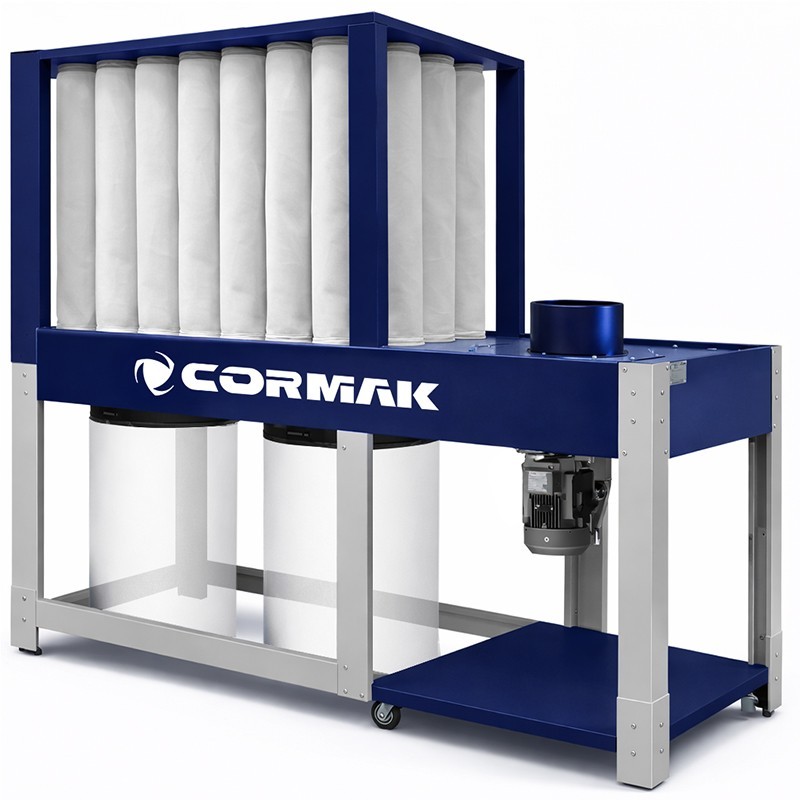
An industrial extraction system draws in contaminants directly from the machine inlets and transports them to bags, containers or filters. It can serve a single workstation or an entire pipework system connected to several woodworking machines.
Industrial units are available in a range of capacity options. Smaller models can be used with a saw, router, sander or planer. Larger systems are designed for production facilities where several workstations operate simultaneously.
The most important advantage is the ability to capture not only sawdust but also fine wood dust. However, the type of filter used is of great importance. A simple fabric bag may trap larger particles, but when sanding, cutting MDF, processing laminated boards or carrying out CNC work, more precise filtration is required.
When should you choose a cyclonic system?
A cyclonic extraction system is a good choice when a lot of heavy sawdust and wood shavings are produced in the joinery workshop. This applies in particular to intensive use of planers, thicknessers, multi-blade saws, routers and machines that remove large amounts of material in a short time.
A cyclone separator is also a good option when filters become clogged quickly and the operator has to empty the bags frequently. Separating larger particles before they reach the filter helps maintain stable dust extraction system performance and reduces maintenance time.
A cyclone system is worth considering when:
- planers and thicknessers are in daily use,
- there is a large amount of coarse chips in the system,
- conventional extraction filters quickly lose their flow capacity,
- the workshop wishes to reduce the frequency of bag emptying,
- stable extraction performance is important during prolonged operation.
However, additional space must be allowed for the separator, the hopper and the ductwork. The system must be airtight, as leaks reduce the suction power at the machine. It is also important to route the ductwork correctly and to select the diameter of the connections to match the actual air flow.
When is an industrial extraction system preferable?
A standard industrial extraction system is suitable for a small or medium-sized joinery workshop with a few basic machines. A compact unit can be positioned next to the workstation or connected via a short duct run.
A larger central extraction system is recommended when machines are operating simultaneously and are located in different parts of the workshop. In such cases, the capacity must be selected to match the number of open extraction points, the diameter of the ducts and the resistance of the entire system.
When manufacturing furniture from MDF, plywood and laminated boards, effective filtration of fine dust is particularly important. A high fan capacity alone is not sufficient if the filter has too small a surface area or fails to capture sufficiently small particles.
Cyclone and filtration – the best combination for a larger joinery workshop
In a busy joinery workshop, a two-stage system may prove the most practical. The cyclone separates most of the shavings and sawdust, whilst the final filter traps fine dust. This combination reduces filter clogging, helps maintain a constant flow and makes it easier to empty the collected waste.
Before purchasing, you should check the air flow rate, negative pressure, diameter of the connection pipes, type of filters and the number of machines operating simultaneously. The length of the ducting, the number of bends, the method of discharging the cleaned air and the possibility of expanding the system in the future are also important.
What should you look out for when selecting an extraction system?
The selection of an extraction system should be based on actual operating conditions. It is not enough to compare motor power alone. What is more important is how much air the unit is capable of effectively moving through the entire system and whether it will maintain an adequate transport speed for sawdust within the ducts.
Before purchasing, it is worth checking:
- the number of machines connected to the system,
- the number of workstations operating simultaneously,
- the diameters of the connections and ducts,
- the type of contaminants generated,
- the surface area and class of the filters,
- the capacity of the bags or hoppers,
- available space in the workshop,
- ease of cleaning and emptying the system.
It is also worth avoiding excessively long hoses, sharp bends and leaky connections. Any additional resistance reduces the effectiveness of the extraction system at the machine. Even a powerful unit may perform poorly if the installation is poorly designed.
Summary
Cyclonic extraction works best with large quantities of sawdust and wood shavings. It reduces the load on filters, makes it easier to empty waste and helps maintain a stable air flow. An industrial extraction system with a suitable filter copes better with fine dust and can serve a single workstation or a larger pipework system.
In larger workshops, the most effective solution is often a combination of a cyclone separator and fine filtration. A well-chosen dust extraction system improves tidiness in the joinery workshop, reduces dust build-up on machinery and helps maintain stable production conditions.
