


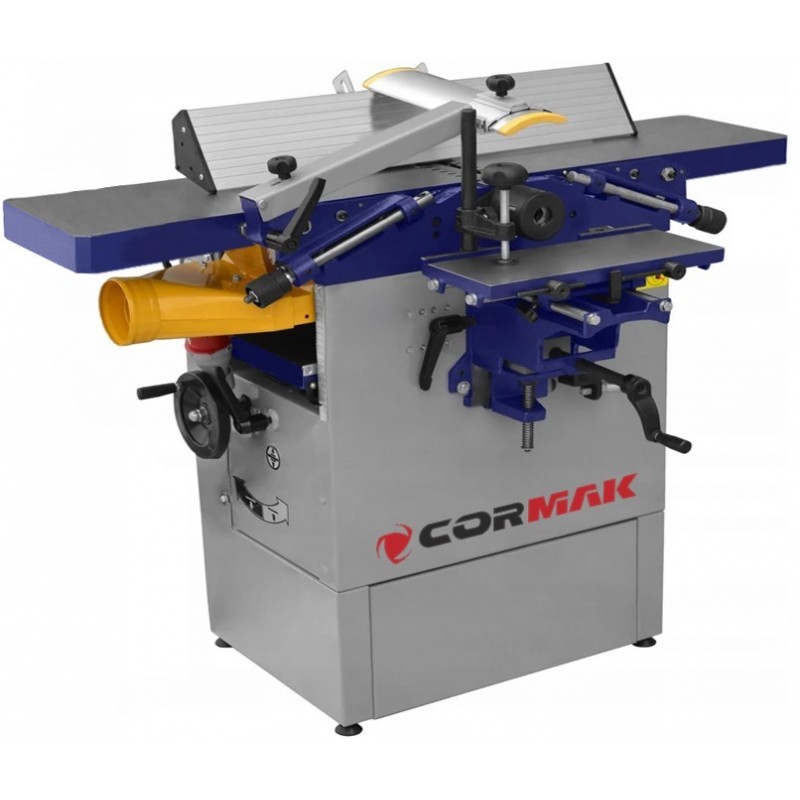
When choosing a planer, thicknesser or planer-thicknesser, it is worth considering more than just the working width, motor power and feed rate. The design of the cutting shaft is also of great importance. It is this component that influences surface quality, noise levels, the load on the machine and subsequent running costs.
When choosing a planer, thicknesser or planer-thicknesser, it is worth paying attention not only to the working width, motor power and feed speed. The design of the cutting shaft is also of great importance. It is this component that influences surface quality, noise levels, the load on the machine and subsequent running costs.
The most common comparison is between the classic knife shaft with long knives and the spiral shaft fitted with many small cutting inserts. Both solutions allow for effective woodworking, but cater to different needs. The knife shaft is simpler and cheaper, whilst the spiral shaft offers greater comfort and better results when working with demanding materials.
How does a classic cutter shaft work?
The knife roller is fitted with several long blades arranged parallel to its axis. As it rotates, each blade comes into contact with the material across almost the entire width of the workpiece.
This design is commonly used in workshop and industrial planers. It works well when machining both soft and hard wood with a relatively regular grain pattern. Correctly aligned and sharpened blades can leave a smooth surface that requires only light sanding.
The main advantage of the classic shaft is the lower purchase cost of the machine. The blades can also be resharpened multiple times, provided they have not been seriously damaged. This is a cost-effective solution for workshops that process standard boards, square-edged timber and structural components.
Limitations of the cutter head
The long blade cuts away a large amount of material at once, which is why a characteristic, high level of noise is produced during operation. The machine may also generate greater vibrations, particularly when the blades are poorly aligned or unevenly sharpened.
Problems also arise with knots and varying grain direction. A standard blade may tear out pieces of wood rather than cutting them cleanly. This results in tears, indentations or ragged edges on the surface, requiring additional sanding.
Damage to a single section of the blade affects the entire working width. Even a slight chip can leave a visible mark on every board being processed. The blade must then be resharpened or replaced, and subsequently aligned precisely with the other blades.
What makes a spiral shaft stand out?
A spiral shaft utilises many small cutting inserts arranged around its circumference. Depending on the design, the inserts may be arranged in a spiral or at a slight angle to the feed direction.
During operation, successive cutting edges gradually penetrate the material. Instead of a single broad cut, a series of smaller cuts takes place. This makes the process smoother, and the machine generally runs more quietly and with less vibration.
The inserts are most commonly made of cemented carbide. Each one has several cutting edges. If one edge becomes blunt or damaged, the insert can be rotated to use the next side. There is no need to replace or adjust the entire set of cutting edges.
Better surface quality
The most important advantage of a spiral shaft is the high quality of planing. The small inserts cut through the wood gradually, thereby reducing the risk of fibre tear-out. The difference is particularly noticeable with knotty, hard wood and materials with an irregular grain.
The spiral cutter performs well on, amongst other things, oak, ash, beech and laminated timber. It can also be advantageous for components with alternating grain directions, where conventional cutters are more likely to leave tear marks.
The surface after machining is usually smoother and requires less intensive sanding. In the production of furniture, stairs, worktops and decorative elements, this helps to shorten subsequent stages of work and reduce the number of rejected items.
Noise, chips and machine load
A spiral shaft usually operates more quietly than a conventional blade shaft. The individual inserts do not strike the material across the entire width simultaneously, thereby reducing noise and vibration levels. However, ear protection should still be worn and the safety guidelines for operating the planer must be followed.
Smaller and shorter chips are also produced during machining. These may be easier to remove via the extraction system, provided that the extraction system has sufficient capacity and the duct diameters are correctly selected.
The gradual penetration of the blades into the material also helps to reduce peak loads on the drive. This does not, however, mean that a machine with a spiral shaft can be fitted with a motor of any size. The power must still be matched to the working width, planing depth, feed rate and the hardness of the timber.
Purchase and running costs
A spiral-shaft planer is usually more expensive than a comparable model with conventional blades. The higher cost stems from the more complex design and the number of inserts used.
Over the long term, however, this difference may be partially recouped. A damaged insert can be rotated or replaced individually, without having to dismantle the entire set of blades. Nor does the operator need to set all the blades to the same height after each sharpening.
A conventional shaft remains more economical for occasional use and simple materials. However, it requires regular sharpening and precise blade adjustment, which takes time and can cause downtime.
Which shaft should you choose?
A classic knife roller is a good choice when:
- the planer is used occasionally,
- the timber being worked on is mainly of a regular grain,
- a lower purchase price is the most important factor,
- the workshop has the facilities to professionally sharpen and set the blades,
- a simple design and easy availability of standard blades are important.
A spiral shaft is worth choosing when the machine is in regular use and high surface quality, lower noise levels and reduced tear-outs are important. It will be particularly useful for hard, knotty and challenging timber, as well as in workshops producing furniture, stairs, doors or finishing elements.
Summary
A knife roller is a simple and economical solution for standard joinery work. With sharp and correctly aligned knives, it ensures good machining quality, but may generate more noise and tear-outs when dealing with difficult grain patterns.
A spiral cutter offers smoother operation, easier blade handling and a better planed surface. It is more expensive, but in regular production it can reduce sanding time, downtime associated with sharpening and the number of damaged workpieces.
