


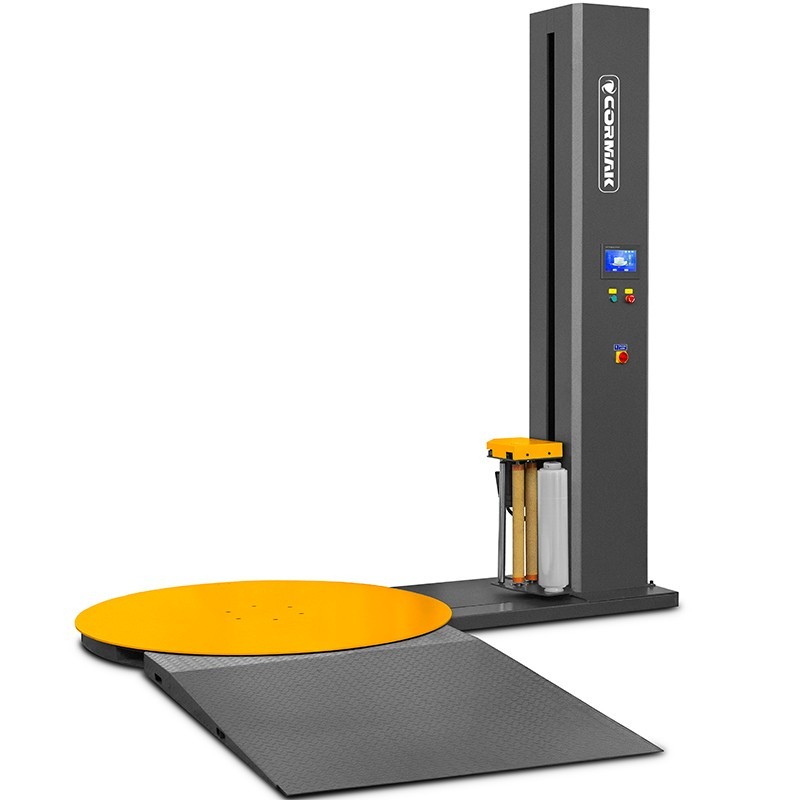
Wrapping pallets by hand with stretch film is a common practice in small warehouses, online shops and production facilities. With just a few pallets a week, it usually isn’t much of a problem. An employee takes a roll of film, wraps it around the load a few times, secures the base and top of the goods, and then passes the pallet on for dispatch. Over time, however, this simple process can start to generate costs, delays and errors.
Wrapping pallets by hand with stretch film is a common practice in small warehouses, online shops and production facilities. With just a few pallets a week, it usually isn’t much of a problem. An employee takes a roll of film, wraps it around the load a few times, secures the base and top of the goods, and then passes the pallet on for dispatch. Over time, however, this simple process can start to generate costs, delays and errors.
The point at which it is worth considering purchasing a pallet wrapper is not determined solely by the number of consignments. Working time, film consumption, the repeatability of the packing process, the type of load and the risk of damage in transit are also important factors. A well-chosen wrapper streamlines the final stage of logistics and, with regular shipments, can become one of the most practical pieces of equipment in the warehouse.
When does manual wrapping cease to be cost-effective?
The first indicator is time. Wrapping a single pallet by hand can take several minutes, especially when the load is tall, irregularly shaped or requires additional layers of film. With a dozen or so, or even several dozen, pallets a day, an employee may spend a large part of their shift on this task. During this time, they are not picking orders, receiving deliveries or preparing consignment notes.
The second sign is the increasing consumption of stretch film. When wrapping by hand, it is difficult to maintain consistent tension in the film and the same number of layers. Operators often secure the load ‘with a margin’, which increases material consumption. The problem is particularly evident with heavy pallets, cardboard boxes stacked high, or goods with irregular shapes.
A stretch wrapper allows you to set a fixed operating cycle. Depending on the model, you can control the number of revolutions, the wrapping speed, the film tension and the reinforcement of the top and bottom of the pallet. This makes material consumption easier to predict and ensures more consistent packaging.
Ergonomics and workplace safety
Walking manually around the pallet with a roll of film puts strain on the back, shoulders and wrists. With tall loads, the worker must also reach above shoulder height or use a platform. During periods of increased dispatch volume, this increases fatigue and the risk of goods being secured incorrectly.
A stretch wrapper reduces the number of repetitive movements. The operator focuses primarily on positioning the pallet correctly, attaching the film and starting the programme. This is particularly important in companies where pallet wrapping is a regular part of the job, rather than an occasional task carried out from time to time.
Consistency in securing the load is important
A pallet must be stable not only when it leaves the warehouse, but also during loading, transport and unloading. Manual wrapping depends on the experience of the individual carrying it out. One pallet may receive a sufficient number of layers, whilst the next may be secured too loosely. Differences may also arise in the tension of the film and the way the top and bottom of the load are reinforced.
A stretch-wrapping machine allows specific parameters to be set. As a result, every pallet is prepared to a set standard. This is particularly important when a company is shipping high-value goods, products susceptible to damage, or loads requiring secure fastening.
Improved consistency can reduce the number of transport-related complaints. Damage is not always caused by the carrier’s fault. Often, the cause is the shifting of cartons, an insufficient number of film layers, or a lack of adequate securing at the base of the pallet.
For which businesses is a pallet wrapper a good choice?
A pallet wrapper is ideal for production facilities, wholesalers, logistics centres, e-commerce warehouses, distribution companies and businesses shipping heavy components. It is useful wherever pallet packing takes place regularly rather than sporadically.
A semi-automatic wrapping machine with a turntable is often a good solution for small and medium-sized businesses. The operator places the pallet on the platform, attaches the film and starts the cycle. Such a machine offers a significant improvement over manual wrapping, without the need to implement extensive automation.
For larger-scale shipments, it is worth considering the number of available programmes, the maximum pallet height, the table’s load capacity and the ability to work with different types of film. Companies handling unstable, very tall or non-standard loads should also analyse how to stabilise the pallet and the additional options available.
How to choose a pallet wrapper?
Before purchasing, you should determine the maximum weight and dimensions of the pallets. The machine’s load capacity, table diameter and permissible load height are key factors. It is also worth calculating the average number of pallets wrapped per day. This allows you to select a machine with a capacity suited to your actual workload, rather than just your current needs.
The type of goods is also important. Lightweight cardboard boxes are secured differently from sacks, barrels, metal components or irregularly shaped products. Before commissioning the machine, it is worth establishing a simple packing procedure: how to position the goods, the use of corner protectors and spacers, and the appropriate number of layers of film.
You also need to plan the workspace. The wrapping machine should be positioned where pallets can be conveniently loaded and unloaded, ideally near the order-picking or loading area. You should allow for a route for a pallet truck or forklift, as well as space for a supply of film.
Frequently asked questions
Does the stretch wrapper replace a worker?
Not entirely. The operator still needs to position the pallet correctly, select the right film and run the appropriate programme. However, the machine automates the most repetitive stage, namely the wrapping itself.
Will a stretch wrapper be suitable for a small number of pallets?
Yes, particularly when the pallets are heavy, tall or require secure protection. Cost-effectiveness depends not only on the number of consignments, but also on operating time, film costs and the risk of damage in transit.
Summary
Manual stretch-wrapping ceases to be cost-effective when it is a constant, repetitive and time-consuming stage of the dispatch process. A pallet wrapper helps to speed up the work, reduce the workload on staff, minimise uncontrolled film wastage and improve load stability.
It is worth considering purchasing such a machine not only when dealing with very large numbers of pallets. Even in a medium-sized warehouse, a pallet wrapper can improve work organisation, raise packaging standards and reduce the risk of damage during transport.
