

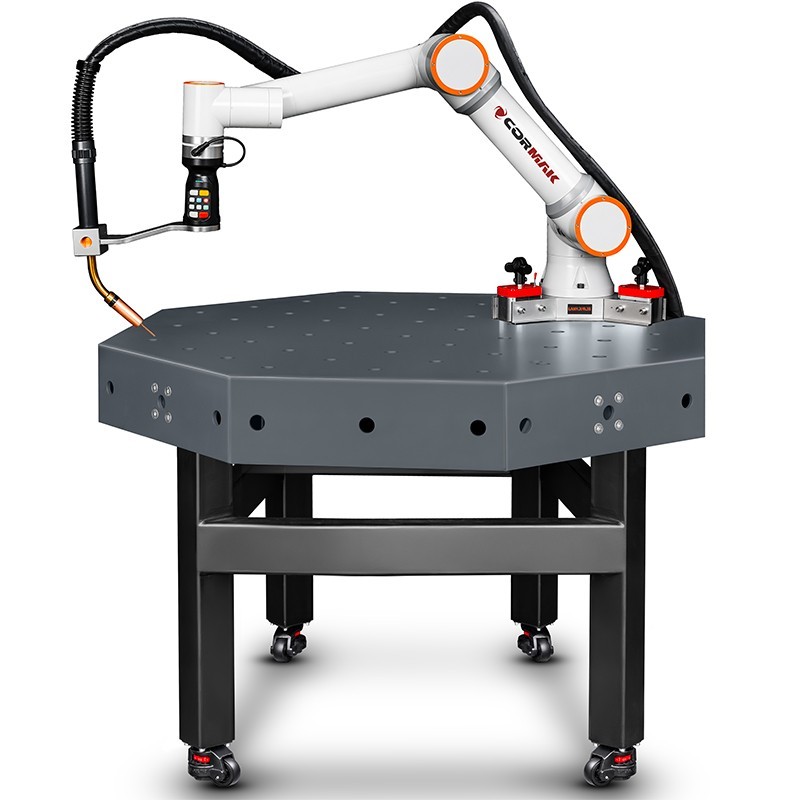
A welding cobot is a solution for companies wishing to improve the repeatability of their welding processes, reduce production times and take the strain off welders when carrying out repetitive tasks. Unlike a traditional industrial robot, a cobot is designed for easier operation, faster programming and operation in smaller production spaces.
A welding cobot is a solution for companies that want to improve the repeatability of welding, reduce production time and relieve welders of the burden of repetitive tasks. Unlike a traditional industrial robot, a cobot is designed for easier operation, faster programming and operation in smaller production spaces.
Welding automation does not always mean setting up a large production line. In many workshops, a workstation comprising a cobot, a welding power source, a workbench and the appropriate tooling is sufficient. This solution can be particularly beneficial for companies that regularly produce similar components but do not wish to invest in extensive robotisation.
What is a welding cobot?
A cobot, or collaborative robot, is a device that performs repetitive welding movements along a pre-programmed path. The operator prepares the workpiece, sets the programme, starts the process and monitors the result. The cobot guides the welding torch at a consistent speed, angle and distance from the material.
Process stability is crucial in welding. Even an experienced welder may find it difficult to maintain consistent quality over many hours of work. A welding cobot performs the same movement repeatedly, thereby helping to minimise variations between successive workpieces.
However, this does not mean that humans are completely replaced. An operator is still needed to prepare the components, select the parameters, set up the clamping, assess the weld and respond in the event of a problem. Automation works best when it combines the repeatability of the machine with the experience of the technician and the welder.
When does welding automation make sense?
Welding automation is most cost-effective when a company produces repeatable components. The more frequently the same weld is performed, the easier it is to recoup the time spent on programme preparation, setting up the workstation and fabricating the jigs.
A welding cobot is ideal for the production of frames, steel structures, brackets, handles, enclosures, machine parts, tables, shelving, gates, fences and components manufactured in short or medium-sized batches. These do not necessarily have to be very large batches. Often, repetitive orders are sufficient, where one can quickly return to the job and reuse a saved programme.
A cobot also makes sense where welders carry out a lot of monotonous, simple welds. Transferring such tasks to a robotic workstation allows staff to be deployed for more complex operations, quality control, production preparation or tasks requiring greater manual expertise.
When might a cobot not be cost-effective?
Not every company will immediately realise a cobot’s full potential. If production is highly customised, with each component looking different and welds being difficult to access, implementation may be less effective. Under such conditions, the time spent on programming, set-up and changeover may exceed the time taken for the welding itself.
Nor will a cobot solve the problem of poorly prepared components. If parts have large gaps, variable dimensions, unstable clamping or poor repeatability after cutting and bending, the robot will simply replicate the errors. Welding robotisation requires a well-prepared process.
Before purchasing, it is worth assessing whether the company has components suitable for automation. The best results are achieved with components that can be securely clamped, positioned in a repeatable manner and welded along a fixed path.
The key benefits of using a cobot
The greatest advantage is repeatability. The cobot guides the torch in exactly the same way during every cycle. As a result, the weld can be more uniform, and quality is easier to maintain in mass production.
The second benefit is productivity. The operator can prepare subsequent components, monitor the process or carry out other tasks whilst the cobot performs the welding. In a well-organised workstation, this reduces production time and minimises downtime.
Ergonomics is also important. Welding long, repetitive seams can be tiring and puts strain on the eyes, hands and back. The cobot takes over the most monotonous parts of the work, allowing the welder to focus on tasks requiring greater skill.
Automation also helps to mitigate the impact of staff shortages. Where there is a shortage of qualified welders, a cobot can stabilise production and reduce reliance on manual labour for repetitive tasks.
What needs to be prepared before implementation?
The most important thing is the jigging. The workpiece should always be positioned in the same way. A well-made welding jig reduces set-up time and helps maintain consistency.
The next consideration is the welding parameters. You need to select the current, voltage, travel speed, shielding gas, type of wire and the sequence of welds. A cobot does not replace welding technology; it simply carries it out in a repeatable manner.
It is also worth analysing the workflow. The workstation should be set up so that the operator can quickly load and unload workpieces. If preparing a component takes too long, the cobot will be left waiting, and the potential of automation will not be fully utilised.
How can you assess the cost-effectiveness of a welding cobot?
The simplest way is to compare the time taken for manual welding with the cobot’s operating time, taking into account loading, unloading, part inspection and any necessary corrections. Key factors include the number of repeatable parts per month, the length of the welds, set-up time and how often a particular batch returns to production.
A cobot will pay for itself more quickly when:
- the workpieces are repeatable and easy to fix in place,
- the welds follow a similar pattern,
- the production runs recur regularly,
- the company has difficulties with the availability of welders,
- the quality of the welds must be consistent,
- the plant wishes to increase production without significantly expanding the workforce.
Cost-effectiveness also increases when a single operator can handle several stages of the process or prepare the next workpieces whilst the cobot is in operation. This is precisely why it is worth analysing the entire process before making a purchase, rather than just the time taken to make a single weld.
Summary
A welding cobot is cost-effective when a company performs repetitive welds and wishes to improve production consistency. It works best with batches of parts that can be easily clamped and welded along a fixed path.
It is not a solution for every process, but in a well-prepared workstation it can reduce working time, improve repeatability and ease the workload on welders. The key to success lies not only in purchasing the equipment, but also in the right tooling, good preparation of the workpieces and well-thought-out production organisation.
