


A correct drill bit cutting angle has a direct impact on the quality of the hole, drilling speed, tool life and operator safety. Incorrectly selected geometry can lead to overheating, run-out, an uneven hole, rapid edge dulling and an increased risk of damage to the drill bit or the workpiece.
A good drill bit cutting angle has a direct impact on the quality of the hole, drilling speed, tool life and operator safety. Incorrectly selected geometry can cause overheating, run-out, an uneven hole, rapid edge dulling and a greater risk of damage to the drill bit or the workpiece.
Therefore, when drilling into steel, aluminium and stainless steel, it is worth knowing which angle to choose, what correct drill bit sharpening looks like, and when a drill bit sharpener is a better option than manual sharpening on a grinder.
What is the drill bit sharpening angle?
The cutting angle, also known as the drill point angle, is the angle between the two main cutting edges. In the most commonly used metal drill bits, angles of 118° and 135° are found, but in practice the geometry should be adapted to the material, the type of tool and the drilling method.
This parameter affects how easily the drill bit penetrates the material, how stable it is during operation, how well it removes chips, and the quality of the resulting hole. Even good metal drill bits lose their sharpness over time, which is why their regrinding requires maintaining the correct angle, edge symmetry and adequate heat dissipation during grinding.
What is the correct sharpening angle for a steel drill bit?
For typical structural steel, an angle of 118° is most commonly used. This is a versatile solution for steel sections, sheet metal, flat bars, angle sections and welded components. A drill bit sharpened at this angle cuts into the material effectively and is suitable for most workshop tasks.
For harder grades of steel, a 135° angle can be used, particularly with HSS-Co cobalt drill bits or tools designed for more demanding machining operations. A flatter tip improves stability, facilitates centring and reduces the risk of the drill bit slipping across the surface.
For larger diameters, it is worth paying attention not only to the angle, but also to the rotational speed, feed rate, cooling and stable clamping of the workpiece. Incorrectly selected parameters can ruin even a correctly sharpened tool.
What is the correct cutting angle for a drill bit used on aluminium?
Aluminium is a soft and ductile material, which is why it can stick to the cutting edges and clog the drill’s flutes during drilling. For aluminium, an angle of approximately 90°–118° is most commonly used, depending on the alloy, thickness and type of hole.
For typical workshop tasks, a standard 118° drill bit will work well, provided it is sharp. For thin sheets or soft aluminium alloys, a smaller angle – for example, 90°–100° – may be preferable, as this makes it easier to start drilling and reduces material displacement.
In aluminium, effective chip removal is very important. Excessively high speeds, blunt edges and a lack of lubrication can cause a rise in temperature, burrs and a reduction in the accuracy of the hole.
What is the recommended cutting angle for a drill bit used on stainless steel?
Stainless steel is more difficult to machine than ordinary structural steel. It dissipates heat less effectively and tends to work-harden during drilling. A 135° angle is most commonly used for stainless steel, or alternatively a range of around 130°–140°.
A drill bit with a 135° angle has a flatter tip, stabilises better on harder surfaces and is more resistant to loads. When working with stainless steel, it is advisable to use cobalt drill bits, coolant, lower speeds and a constant feed rate. A feed rate that is too slow can cause the tool to slip and the material to harden, whilst a speed that is too high quickly leads to overheating.
Approximate sharpening angles for drill bits
| Material | Approximate angle | Practical notes |
|---|---|---|
| Structural steel | 118° | A versatile choice for most workshop tasks. |
| Harder steel | 135° | Better centring and more stable performance under heavier loads. |
| Aluminium | 90°–118° | Requires a sharp tool, good chip removal and lubrication. |
| Stainless steel | 130°–140°, often 135° | Requires cooling, lower speeds and a steady feed rate. |
The values given are approximate. The final selection depends on the type of drill bit, diameter, material, machine, cooling and the tool manufacturer’s recommendations.
Drill bit sharpening – why is it worth doing regularly?
A sharp drill bit cuts through the material evenly, does not require excessive pressure and removes chips more effectively. A blunt tool, rather than cutting, begins to push the material aside. This causes overheating, places a greater load on the machine, results in poorer hole quality and leads to faster tool wear.
Regular drill bit sharpening extends their service life and ensures consistent hole quality. This is particularly important in metalworking shops, workshops, tool rooms and production facilities, where drill bits are used on a daily basis.
Regenerating drill bits is particularly cost-effective for more expensive cobalt and carbide tools, as well as when working frequently with stainless steel. Instead of discarding blunt tools, their geometry can be restored and they can be reused in production.
Manual sharpening or a drill bit sharpener?
Many workshops still use manual sharpening on a bench grinder. This is possible, but it requires experience. You need to maintain the correct angle, ensure both cutting edges are of equal length, and prevent the steel from overheating. If one cutting edge is longer than the other, the drill bit will wobble, and the hole may end up larger than the nominal diameter.
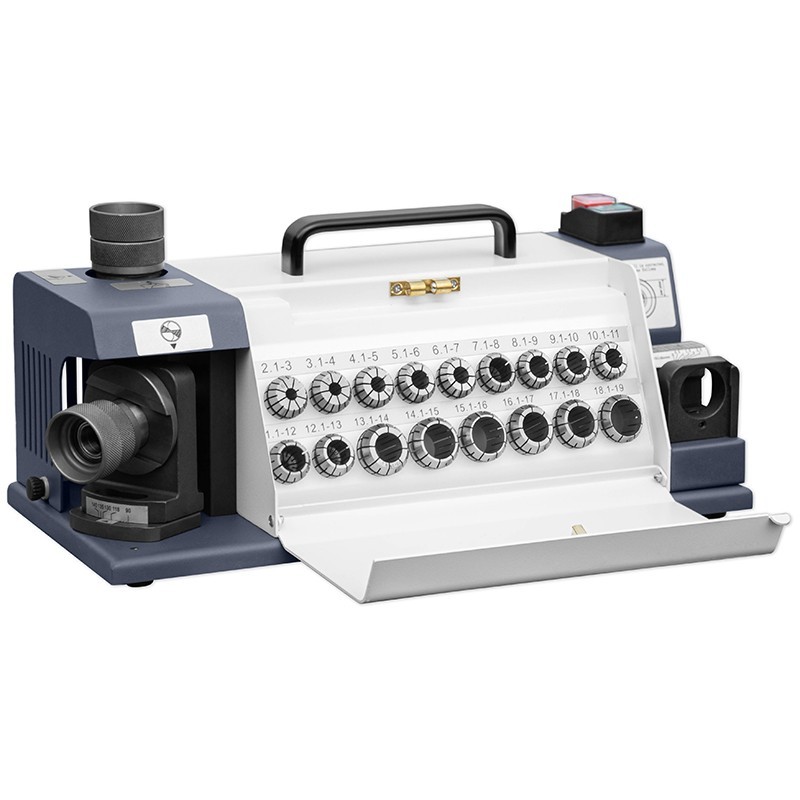
A better solution for many companies is a drill bit sharpener or a professional sharpening machine. Such a device helps to set the correct angle, speeds up the work and minimises operator error. It is particularly useful where a large number of drill bits are sharpened and consistency is key.
Good drill bit sharpeners allow you to get the tool back into working order more quickly, maintain symmetry and minimise ‘by eye’ sharpening. This translates into better-quality holes and a lower risk of damaging workpieces.
How do you position a drill bit correctly in a sharpener?
To position a drill bit correctly in a sharpener, you must first select a chuck, sleeve or adapter to match the tool’s diameter. The drill bit should be held securely, without any play, misalignment or accidental slippage.
- Check the drill bit’s diameter and the sharpener’s operating range.
- Select the correct collet or guide sleeve.
- Set the required sharpening angle according to the material and type of tool.
- Clamp the drill bit symmetrically so that both edges are sharpened evenly.
- Carry out the sharpening without applying excessive pressure and without overheating the cutting edges.
- After sharpening, check the symmetry, sharpness and condition of the drill bit tip.
Correct positioning of the drill bit in the sharpener helps to maintain its geometry, protects the cutting edges and reduces the risk of errors during drilling.
The most common mistakes when sharpening drill bits
- uneven cutting edges – cause runout and enlargement of the hole;
- incorrect sharpening angle – hinders penetration into the material or weakens the cutting edge;
- overheating of the drill bit – can reduce the service life of the cutting edge;
- lack of symmetry – leads to uneven performance and reduced accuracy;
- sharpening all drill bits in the same way – different materials and tool types require different geometries;
- failing to check the drill after sharpening – even a small error can compromise the quality of the hole.
Can all drill bits be sharpened in the same way?
Not every drill bit is sharpened in the same way. Standard HSS metal drill bits have a different geometry to concrete drill bits, step drill bits, special-purpose drill bits or carbide drill bits. Before sharpening, it is worth checking the type of tool and the manufacturer’s recommendations.
For standard HSS drill bits, the most important thing is to maintain the correct angle, symmetry and sharpness of the cutting edges. With more expensive tools, it is worth using equipment that allows for consistent sharpening, without overheating and without accidentally altering the geometry.
Summary
For standard steel, an angle of 118° is most commonly chosen; for aluminium, a range of approximately 90°–118°; and for stainless steel, 135° is most common. These are approximate values which should be adjusted according to the type of drill bit, material, diameter and operating conditions.
The correct sharpening angle, sharp edges and regular checks of the geometry improve the quality of the holes, reduce tool wear and minimise the risk of workpiece damage. For frequent drilling, it is worth using a drill bit sharpener, which helps to maintain consistency, reduces re-sharpening time and helps keep tools in good condition for longer.
