


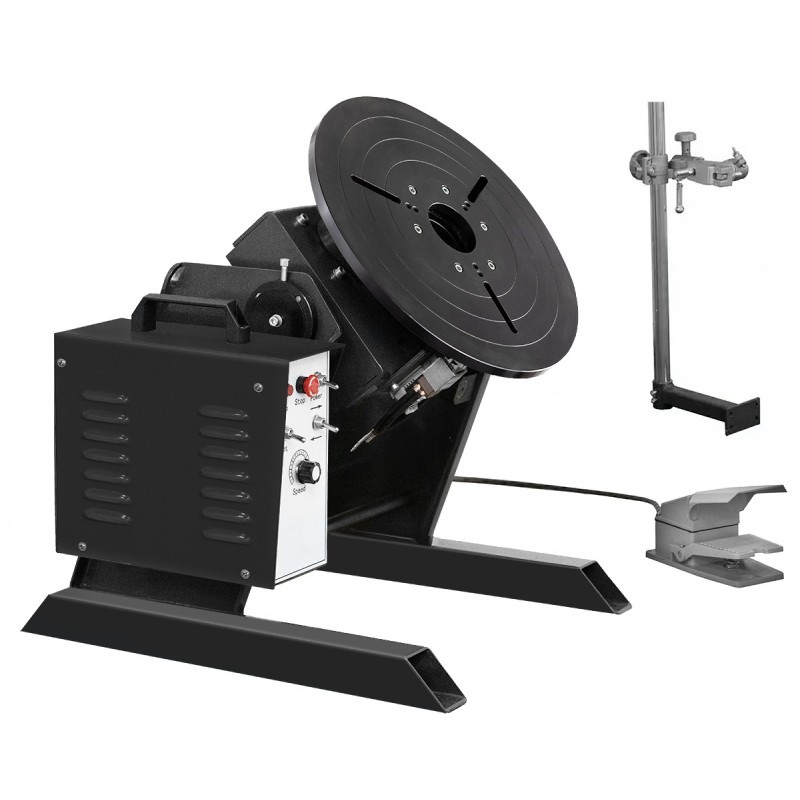
A welding positioner is a device that helps to position a workpiece in a comfortable, stable and safe position for welding. Instead of manually rotating a heavy workpiece, the operator can rotate it about an axis, tilt it to the required angle and hold it in a controlled position whilst working.
A welding positioner is a device that helps to position a workpiece in a comfortable, stable and safe position for welding. Instead of manually rotating a heavy workpiece, the operator can rotate it around an axis, tilt it to the required angle and hold it in a controlled position whilst working.
This solution improves access to the joint, makes it easier to guide the torch and enhances the repeatability of the process. Welding positioners are used in workshops, metalworking shops, service centres, maintenance departments and production facilities where weld quality, ergonomics and efficient workstation organisation are paramount.
What is a welding positioner?
A welding positioner is a device designed to rotate, tilt or position the workpiece in a way that facilitates welding. In practice, it allows the workpiece to be moved into a position where the welder has better visibility, more convenient access and greater control over the weld pool.
A welding positioner does not replace proper material preparation, clamping, welding parameters or the operator’s qualifications. However, it is an important element of workstation organisation, as it reduces the need for manual handling of the workpiece and helps maintain consistent working conditions.
What is a welding positioner used for?
The main task of a positioner is to position the workpiece in the most favourable position for welding. The operator can rotate the workpiece, tilt it and stabilise it so that the weld path is easier to control and more predictable.
Welding positioners are used, amongst other things, for welding:
- pipes, flanges and nozzles;
- tanks, sleeves and cylindrical components;
- frames, sections and steel structures;
- machine parts and assembly components;
- components requiring circumferential welding;
- mass-produced components where repeatability is key.
This configuration allows the welder to work more steadily, without having to move around the workpiece frequently or manually reposition heavy components.
Construction of a welding positioner
The design depends on the model and load capacity, but a typical positioner consists of several basic assemblies.
Work table or clamping disc
This is the component to which the workpiece, clamp, fixture or clamping equipment is secured. The table rotates during operation, so it must provide stable support and ensure an appropriate spacing between the clamping points.
Drive mechanism
The drive is responsible for the rotational movement and for maintaining the set speed. Many devices feature stepless speed control, which allows the operating speed to be adjusted to the workpiece diameter, the type of weld and the welding method.
Tilt mechanism
Tilt angle adjustment allows the workpiece to be positioned in a way that facilitates welding. The wider the tilt range, the easier it is to adapt the machine to different tasks.
Support frame
The body provides rigidity and stability to the entire structure. This is particularly important when working with heavier workpieces, at greater outreach, and under asymmetrical loads.
Controls
The positioner can be operated via a control panel, a rotary knob, a foot pedal or an external control unit. For simple applications, manual adjustment is sufficient, whilst in mass production, smooth speed control and convenient operation without taking your hands off the process are useful.
How the positioner works
The positioner’s operation is simple: the workpiece is clamped to the worktable, positioned at the correct angle, and then rotation is initiated. The device holds the workpiece in a stable position and rotates it at a speed suited to the welding process.
For circumferential welds, the operator can guide the torch within a single, comfortable zone, whilst the rotating workpiece moves the welding position in front of the torch. This makes it easier to maintain a constant torch angle, an even distance from the material and a consistent welding speed.
The positioner can be used for manual and semi-automatic welding, as well as in simple automated workstations. In every case, it is essential to secure the workpiece correctly and to select parameters appropriate to the workpiece’s mass, geometry and centre of gravity.
Key parameters of a welding positioner
When selecting a positioner, it is worth considering more than just the maximum load capacity. Equally important are the workpiece dimensions, the clamping method, the tilt range and operational stability at low speeds.
- Load capacity of the device – this should be matched to the weight of the workpiece, the clamp and the clamping accessories.
- Centre of gravity – a workpiece offset from the axis of rotation may place a different load on the device than its mass alone would suggest.
- Table diameter – this affects the ability to clamp the workpiece securely.
- Tilt range – allows the workpiece to be positioned in a convenient working position.
- Speed range – important for circumferential welds and when working with different diameters.
- Control method – control panel, potentiometer, foot pedal or integration with other equipment.
- Structural stability – essential for larger workpieces and asymmetrical loads.
- Ability to mount clamps – useful for pipes, flanges, sleeves and mass-produced workpieces.
Why use a positioner?
The greatest advantage of a positioner is improved control over the welding process. A workpiece that is stably positioned and rotated evenly makes it easier to guide the weld without sudden changes in the operator’s position.
Better weld quality
A positioner helps maintain a constant torch angle, a consistent travel speed and convenient access to the joint. This can reduce the risk of an uneven weld face, lack of fusion, excessive weld overlap or the need for rework.
Greater repeatability
In batch production, the positioner makes it easier to process successive workpieces under similar conditions. The operator can repeat the angle, clamping and rotation speed settings, which contributes to a more stable process.
Improved ergonomics
The welder does not have to work in an awkward position or manually rotate heavy components. Reduced fatigue can improve movement precision and working comfort over longer periods.
Higher workstation productivity
Less manual repositioning of the workpiece means shorter set-up times and a smoother workflow. In many tasks, the positioner reduces the number of breaks needed to reposition the workpiece.
How to choose a positioner for your workstation?
The selection of a positioner should begin with an analysis of the actual workpieces and the working method. It is worth preparing a list of the most frequently welded components, including their weight, diameters, dimensions, clamping method and the required welding position.
- Determine the weight of the workpiece including the clamping fixture – take into account not only the component itself but also the clamping devices.
- Check the position of the centre of gravity – for asymmetrical workpieces, this has a significant impact on safety and the load on the drive.
- Select the table diameter – the table should allow for secure and repeatable clamping.
- Check the tilt range – the more varied the workpieces, the more important angle adjustment becomes.
- Check the rotational speed – it should correspond to the workpiece diameter and the required weld travel speed.
- Assess the control system – a foot pedal may be useful for manual welding, whilst smooth and repeatable adjustment is essential for batch production.
Welding positioner – key features at a glance
| Component | Role in the positioner’s operation | What to look out for? |
|---|---|---|
| Work table | Secures and rotates the workpiece | Diameter, mounting holes, compatibility with clamps |
| Drive | Responsible for rotation and speed stability | Rotation range, smoothness of adjustment, operation under load |
| Tilt mechanism | Positions the workpiece at the correct angle | Adjustment range and position lock |
| Control | Facilitates process control | Control panel, foot pedal, direction of rotation, speed control |
| Body | Ensures rigidity and stability | Mass, design, resistance to asymmetrical loads |
Safety when working with a positioner
A positioner improves safety only if it is correctly selected and used as intended. The workpiece must be securely fixed, and its weight and centre of gravity must not exceed the device’s capacity.
- Do not exceed the positioner’s rated load capacity;
- take into account the mass of the gripper and clamping accessories;
- check that the workpiece is securely fastened before starting rotation;
- do not put your hands into moving parts whilst the machine is in operation;
- secure welding cables to prevent them from being pulled in or damaged;
- follow health and safety procedures, use personal protective equipment and carry out a risk assessment for the workstation.
Summary
A welding positioner works by stably positioning, tilting and rotating the workpiece into a position suitable for welding. It usually consists of a work table, a drive unit, a body, a tilting mechanism, clamping elements and a control system.
A well-chosen positioner improves access to the weld, makes the operator’s work easier, increases repeatability and helps achieve higher-quality joints. When making a selection, it is worth analysing not only the load capacity but also the centre of gravity, the clamping method, the tilt range, the rotational speed and the safety requirements of the workstation.
