


Drill bits are among the essential tools used in workshops, production facilities, tool rooms, service centres and maintenance departments. Their condition has a direct impact on the quality of the holes drilled, the rate of work, operator safety and operating costs. A blunt drill bit slows down machining, causes the material to overheat, increases the load on the machine and can lead to damage to the workpiece.
Drill bits are among the essential tools used in workshops, production facilities, tool rooms, service centres and maintenance departments. Their condition has a direct impact on the quality of the holes drilled, the rate of work, operator safety and operating costs. A blunt drill bit slows down machining, causes the material to overheat, increases the load on the machine and can lead to damage to the workpiece.
In many companies, the standard solution is to use external sharpening services. This is convenient, but not always quick or cost-effective. An alternative is a drill bit sharpener, which allows tools to be reconditioned on-site, without having to send them off-site. A well-chosen sharpener can streamline day-to-day operations, minimise downtime and reduce tool maintenance costs.
Why is it worth sharpening drill bits regularly?
During use, a drill bit gradually loses its correct cutting geometry. The cutting edges, the tip of the tool and the surfaces responsible for guiding the bit through the material all wear down. Signs of dulling include slower drilling, the need to apply greater pressure, squeaking, vibration, the drill bit overheating and a deterioration in the quality of the hole.
Working with a blunt tool is inefficient and costly. It can accelerate wear on a bench drill, drill and milling machine or other machinery, as well as increasing the risk of errors during machining. Regular sharpening of drill bits restores the tools’ performance and extends their service life.
- lower cutting resistance;
- better quality and repeatability of holes;
- reduced risk of material overheating;
- reduced wear on drill bits;
- greater control over the drilling process.
External sharpening services – advantages and limitations
Using external services has its advantages. There is no need to invest in additional equipment, and the sharpening is carried out by a specialist service provider. This solution can be beneficial when a company sharpens only a small number of drill bits, uses specialised tools only occasionally, or does not wish to involve staff in operating additional machinery.
In practice, however, outsourcing sharpening comes with a few limitations. The biggest problem is often the waiting time. The drill bits need to be collected, labelled, sent to the service centre and then collected again. When a plant is operating at full capacity, this can mean downtime or the need to maintain a larger stock of tools.
The second aspect is recurring costs. A single service may seem like a minor expense, but with a larger number of drill bits, the costs rise quickly. Added to this are transport, logistics, monitoring deadlines and staff time. The company also lacks full control over when the tools will return to production.
An in-house drill bit sharpener – independence and rapid response
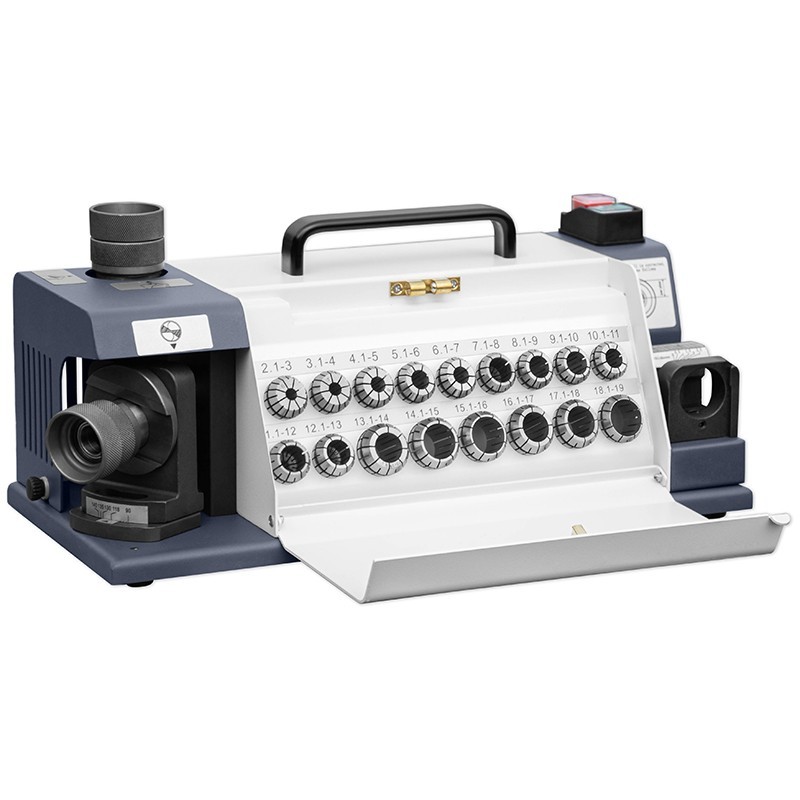
A drill bit sharpener is a device designed to restore the geometry of cutting edges. It allows the tool’s sharpness to be quickly restored without the need for an external service provider. This means the sharpening process can be carried out on-site, allowing work to resume almost immediately.
Modern sharpeners are designed to ensure that operation is simple and repeatable. In many models, the sharpening process follows a specific procedure, which makes it easier to achieve the correct angle, blade symmetry and consistent performance. This is particularly important where several operators use the tools.
Having your own sharpener does not replace technical knowledge. The operator should still know when a drill bit is suitable for reconditioning, how to select the correct settings, and when the tool is too worn or damaged. However, a properly calibrated machine makes it significantly easier to keep standard drill bits ready for use.
The key benefits of owning a drill bit sharpener
Lower tool costs
The greatest advantage is the ability to reuse the same drill bits multiple times. Instead of discarding a blunt tool or sending it for servicing, you can resharpen its cutting edges directly in the workshop. The savings are particularly noticeable with larger-diameter drill bits, which are more expensive than the common smaller sizes.
Less downtime
Not having a sharp drill bit of the right size can bring work to a standstill. Having your own sharpener allows you to react immediately, rather than waiting for a new tool to be delivered or returned from a service centre. This is crucial for maintenance, one-off production, short runs and repair work.
Greater control over quality
The company decides for itself when to sharpen the tools and what condition to maintain them in. This makes it easier to minimise situations where an operator is working with an excessively blunt drill bit. Regular sharpening helps maintain better hole quality and more predictable machine performance.
Better organisation of the tool room
Having your own sharpening machine makes it easier to organise the tool cycle. Drill bits do not have to wait in bundles for dispatch, and the maintenance department can prepare a set of tools for a specific task more quickly. This is particularly useful in companies where many workstations use the same diameters.
Reduced strain on machinery
A well-sharpened drill bit requires less pressure and operates more stably. This can reduce vibration, overheating and unnecessary strain on the machine. As a result, drilling is more predictable and safer for both the operator and the workpiece.
When is a drill bit sharpener particularly cost-effective?
A drill bit sharpener is ideal wherever drill bits are used regularly and in large quantities. This applies to metalworking workshops, manufacturing plants, tool rooms, maintenance departments, technical service centres, technical colleges, installation companies and mechanical workshops.
Cost-effectiveness depends on several factors:
- the number of drill bits sharpened per month;
- the diameters and value of the tools used;
- the cost of external sharpening services;
- the cost of downtime and logistics;
- the required quality and consistency of the holes;
- availability of a member of staff who can operate the sharpening machine.
The more frequently a company uses drill bits and the higher the costs of replacing or having them reconditioned externally, the more justified the purchase of its own machine becomes.
How to choose the best drill bit sharpener?
The best drill bit sharpener is not always the largest or most sophisticated model. The best choice is a machine tailored to the actual tasks carried out in the workshop. For one user, a wide range of diameters will be key; for another, quick set-up, simple operation or consistent cutting edge geometry.
Range of diameters
The machine should accommodate the drill bit diameters most commonly used in the company. Before purchasing, it is worth checking whether the sharpener covers both standard sizes and larger drill bits used for more demanding tasks.
Type of drill bits to be sharpened
Not every sharpener is suitable for all types of tools. You should check whether the machine is designed for HSS drills, cobalt drills and metal drills, and whether it can handle the geometry required in your particular workshop.
Repeatability of settings
It is important that the machine facilitates the maintenance of the angle, blade symmetry and axial alignment. Repeatability is of great importance when several operators use the sharpener or when a company sharpens many drills of the same type.
Quality of the grinding wheel
The grinding wheel determines the quality of the sharpening and the durability of the entire process. It is worth paying attention to its type, the availability of consumable parts and how easy it is to replace.
Structural stability
A robust construction makes it easier to maintain the correct settings and reduces vibration. This is particularly important when sharpening larger diameters and during intensive workshop use.
Ease of use
The simpler the setup and operation, the more likely the sharpener is to be used on a daily basis. The machine should allow for quick preparation of the drill bit and consistent sharpening without lengthy set-up times.
A drill bit sharpener or an external service?
| Criterion | In-house drill bit sharpener | External sharpening service |
|---|---|---|
| Response time | Sharpening can be carried out immediately on-site | Depends on service and transport lead times |
| Cost with frequent use | May be lower with regular sharpening of multiple drill bits | The cost increases with the number of tools |
| Control over the process | Full control over the timing and condition of the tools | Less impact on the schedule and availability |
| Requirements | Purchase of equipment and operator training | No investment in machinery required, but logistics are needed |
| Best uses | Workshops and workshops that frequently use drill bits | Occasional sharpening or specialist tools |
The most common mistakes when sharpening drill bits yourself
- sharpening tools that are too worn – not every drill bit is worth refurbishing;
- failure to check for symmetry – uneven edges can cause runout and enlargement of the hole;
- overheating the drill bit – this can impair the tool material’s properties;
- incorrect sharpening angle – this affects cutting performance, tool life and the quality of the hole;
- failing to clean the tool – dirt makes it difficult to assess the condition of the cutting edges;
- failure to select the correct drill – cracked, excessively shortened or damaged tools may be unsuitable for further use.
FAQ – frequently asked questions
Can a drill bit sharpener replace an external sharpening service?
In many everyday applications, yes, particularly for standard drill bits used regularly. For specialised tools or those with unusual geometries, a specialist service may still be required.
How can you tell if a drill bit needs sharpening?
Typical signs include slower drilling, overheating, increased pressure, vibrations, a squeaking noise, burrs on the edge of the hole and a deterioration in surface quality.
Is it difficult to sharpen drills yourself?
It depends on the machine and the quality requirements. Good sharpening machines guide the operator through the process, but basic technical knowledge, correct set-up and checking the results are still important.
For whom would purchasing a sharpening machine be most cost-effective?
For companies that drill frequently, use up a lot of drill bits, incur regular costs for external sharpening, or cannot afford downtime resulting from a lack of sharp tools.
Summary
A drill bit sharpener is a practical alternative to external sharpening services. It helps to reduce tool running costs, minimise downtime, improve control over work quality and extend the service life of drill bits. For businesses that use drill bits regularly, purchasing such a machine can result in tangible savings.
The best drill bit sharpener is one that is suited to the workshop’s day-to-day tasks: it handles the correct diameters, is easy to use, ensures consistent cutting edge geometry, and has readily available consumable parts. Sharpening in-house gives a company greater independence and allows it to react more quickly when a tool loses its sharpness.
