


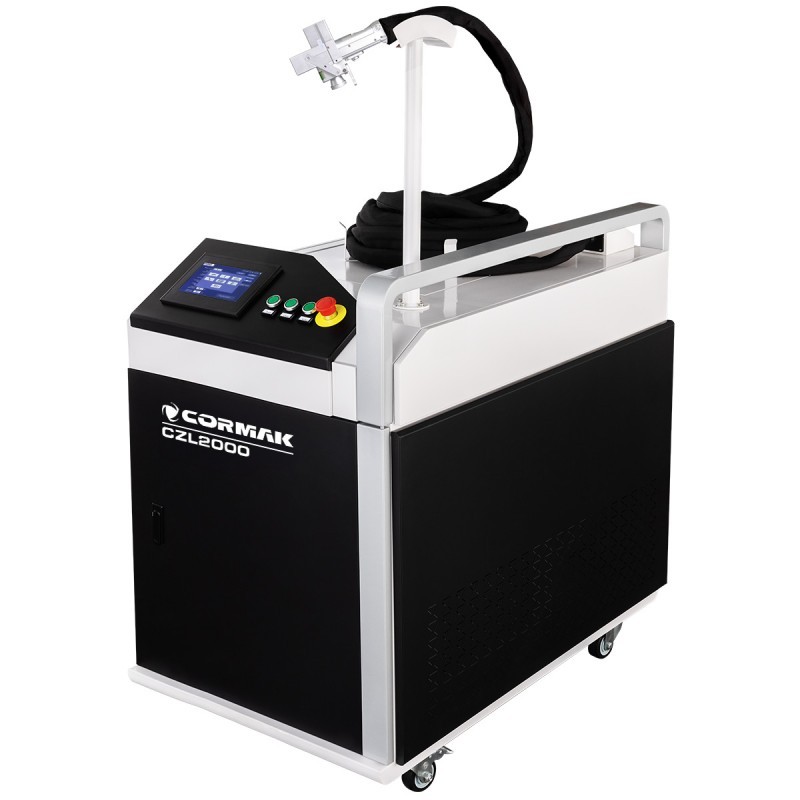
Laser cleaning is a method of removing rust, coatings, oxides, deposits and other contaminants from surfaces. The laser beam primarily interacts with the layer to be removed, which is why the process can be precise, non-contact and minimises the use of abrasives and chemicals.
Laser cleaning is a method of removing rust, coatings, oxides, deposits and other contaminants from surfaces. The laser beam primarily interacts with the layer to be removed, which is why the process can be precise, non-contact and minimise the use of abrasives and chemicals.
The most important choice concerns the method of energy emission: a pulsed laser operates in series of short pulses, whilst a CW laser emits a beam continuously. There is no single solution that is best for all applications. The choice depends primarily on the base material, the type of contamination, the required surface quality, the scale of the work and the organisation of a safe working area.
How does laser cleaning work?
The head guides the beam across the surface, usually scanning it within a specific working area. A layer of rust, paint, oxides, oil or scale absorbs energy differently to the base material. With the correct parameters selected, the contamination can be loosened, vaporised or broken down, whilst the substrate remains prepared for the next process, such as welding, painting or bonding.
Effectiveness does not depend solely on the power of the device. Other factors are also important: the energy and frequency of the pulses or continuous power, the spot diameter, the scanning width and speed, the working distance, the surface condition, the layer thickness and the way the head is guided. Therefore, the optimal settings are always determined on a sample representative of the actual workpiece.
Pulsed cleaning laser
A pulsed laser delivers energy in short, repetitive pulses. This mode of operation allows high peak power to be achieved in a very short time, whilst the surface has time to dissipate some of the heat between pulses. In practice, this provides a high degree of control over the removal of thin layers and the localised application of energy.
Where is it most effective?
- cleaning precision components and surfaces requiring a high-quality finish;
- removal of light to moderate rust, oxides, tarnish and post-weld discolouration;
- cleaning of moulds, tools, jigs and high-value parts;
- working with stainless steel, aluminium and thin sheet metal where minimising thermal effects is important;
- selective removal of thin coatings without intensive heating of the entire workpiece.
Key benefits
In pulsed mode, it is easier to precisely control the energy delivery over a small area. When configured correctly, this can reduce the risk of overheating, discolouration or changes to the surface structure. For this reason, pulsed lasers are often chosen for tasks where preserving the quality of the base surface is just as important as removing contamination.
Limitations
A pulsed laser is not automatically slower or faster than a CW laser – the result depends on the specific coating, working area and parameters. However, for very thick, extensive coatings or on large structures, a device designed for precision cleaning may be less practical than a high-throughput CW system. It also usually requires greater expertise when selecting the pulse energy, frequency and scanning mode.
CW cleaning laser – continuous beam
A CW (continuous wave) laser emits energy continuously. Thanks to its stable, uninterrupted beam, it can deliver high average power to the surface and quickly tackle heavier contamination. This solution is often chosen for tasks where the priority is the speed of cleaning a large area.
Where does it work best?
- large surfaces of steel structures, frames, profiles and machine components;
- thick rust, old paint coatings and stubborn industrial deposits;
- preparatory work prior to welding or painting on larger components;
- tasks where high surface output is important.
Key benefits
The continuous beam allows for rapid energy delivery, making it highly effective in larger-scale industrial applications. With the head correctly positioned, it enables the efficient removal of layers that would be time-consuming to remove using manual methods such as grinding or scraping.
Limitations
The continuous delivery of energy makes heat control all the more important. Incorrect power settings, too slow a head feed rate or too short a working distance can leave marks, cause discolouration or locally overheat the substrate. Therefore, a CW laser is not always the right choice for thin, decorative or particularly sensitive components.
Pulsed vs CW lasers – key differences
| Criterion | Pulsed laser | CW laser |
|---|---|---|
| Emission mode | Short, controlled pulses | Continuous beam |
| Main priority | Precision, selectivity and minimisation of thermal effects | High average power and surface output |
| Typical applications | Oxides, discolouration, light coatings, precision components | Heavier rust, old paint, large structures and heavier soiling |
| Sensitive materials | Often easier to control on thin and high-value parts | Requires particular attention to parameters and trial runs |
| Power selection | It is not only the average power that matters, but also the pulse energy and frequency | Continuous power, spot diameter and scanning speed are key |
| Risk of errors | Incorrect parameters may leave a residue or cause the surface to become matt | Incorrect parameters may cause excessive heating and thermal marks |
In practice, one should compare not just the power values stated on the rating plate, but the results of tests carried out on the specific material. A power of 100 W in a pulsed laser and a power of 1,000 W in a CW system describe different modes of energy delivery; therefore, they are not simply equivalent in terms of cleaning effectiveness.
How do you choose the right technology for the job?
Choose a pulsed laser when:
- control over the effect is paramount and the surface must retain a high quality;
- you are cleaning aluminium, stainless steel, thin sheet metal, moulds, tools or precision parts;
- you are removing oxides, post-weld discolouration, scale, light rust or thin coatings;
- the component is expensive, difficult to access or damage to it would incur high costs;
- you need to clean only specific areas selectively.
Consider a CW laser when:
- you are cleaning large, massive and durable steel structures;
- the main criterion is efficiency over a larger surface area;
- you are removing thicker rust, old paint or firmly adhering contaminants;
- the process involves repetitive preparatory work prior to further processing.
The safest method of selection is to carry out a test on the actual surface. The test should be carried out on the same material, with a similar coating thickness and in the desired surface condition. This allows you to assess the cleaning rate, the quality of the substrate, any residues left after the process, and the need for extraction.
Parameters affecting the cleaning effect
For both types of equipment, the process configuration is fundamental. Too low an energy level may fail to remove the layer completely, whilst too high a level may cause excessive damage to the base material.
- Average power or CW power: determines the amount of energy delivered over time.
- Pulse energy and frequency: in pulsed lasers, these determine the nature of the interaction and the operating rate.
- Scan width and pattern: these affect surface coverage and the uniformity of the result.
- Head travel speed: if too slow, it may increase heat input; if too fast, it may leave residues.
- Focus and working distance: these determine the energy density on the surface.
- Type of coating: loose rust, paint, oxides, oils and residues from manufacturing processes react differently.
- Base material: carbon steel, stainless steel and aluminium differ in terms of thermal conductivity, beam reflection and surface sensitivity.
Common errors and problems
- Selection based solely on power: power alone is no substitute for an analysis of the coating, the workpiece and the probe parameters.
- Lack of a technical trial: settings from a different material or device may not guarantee a similar result.
- Moving the head too slowly: this can cause unnecessary heating and marks on the material.
- Lack of focus control: an incorrect working distance reduces efficiency and compromises repeatability.
- Failure to provide extraction: the removed layer does not simply vanish – dust, smoke or aerosols may be generated that require capture.
- Assuming that the laser will not damage the substrate: every process requires validation on a sample and the correct parameters.
Safety and contamination extraction
Laser cleaning requires the workstation to be organised in accordance with the equipment class, the manufacturer’s instructions and the risk assessment. Manual open-beam systems can pose a serious risk to eyes and skin, and the interaction of the laser with the coating may generate dust, fumes and vapours.
- use the protective measures specified for the specific wavelength and laser class;
- designate and mark out the work area, restricting access to unauthorised persons;
- use local exhaust ventilation suitable for the type of coating being removed;
- check the condition of protective screens, optics and safety components;
- ensure that operators are trained and that start-up and shutdown procedures, as well as safe storage of the equipment, are followed;
- do not clean coatings of unknown composition without a risk assessment and an appropriate extraction strategy.
Safety is not an afterthought in the process. Well-designed extraction and zone control help to protect the operator, maintain the cleanliness of the optics and ensure consistent cleaning quality.
FAQ – frequently asked questions
Is a pulsed laser always better than a CW laser?
No. A pulsed laser typically offers greater control over precise layer removal, but a CW system may be more suitable for large, heavily soiled surfaces. The choice depends on the task and technical trials.
Will a CW laser remove rust more quickly?
It can be very efficient on large and heavy components, but the actual speed depends on the thickness of the rust, the power, the scanning area, the tracking method and the required cleanliness standard. Speed should not be assessed solely on the basis of nominal power.
Is laser cleaning completely waste-free?
No. The process does not usually require sand or abrasives, but the removed rust, paint or deposits may generate dust, particles and fumes. These must be captured and disposed of in accordance with the type of contaminant.
Can aluminium and stainless steel be cleaned?
Yes, although they require careful selection of parameters and testing. In particular, the thermal impact, surface appearance and the risk of leaving marks after the process must be monitored.
Summary
Pulsed and CW lasers are used for different, often complementary, tasks. A pulsed laser is usually preferred when precision, selectivity and minimising thermal effects are important. CW lasers may be advantageous when the priority is the efficient cleaning of larger, resistant surfaces.
The best choice is not determined solely by the type of source or the wattage. It requires an assessment of the material, the type of contamination, the expected quality, process throughput, safety and the results of pilot tests.
