


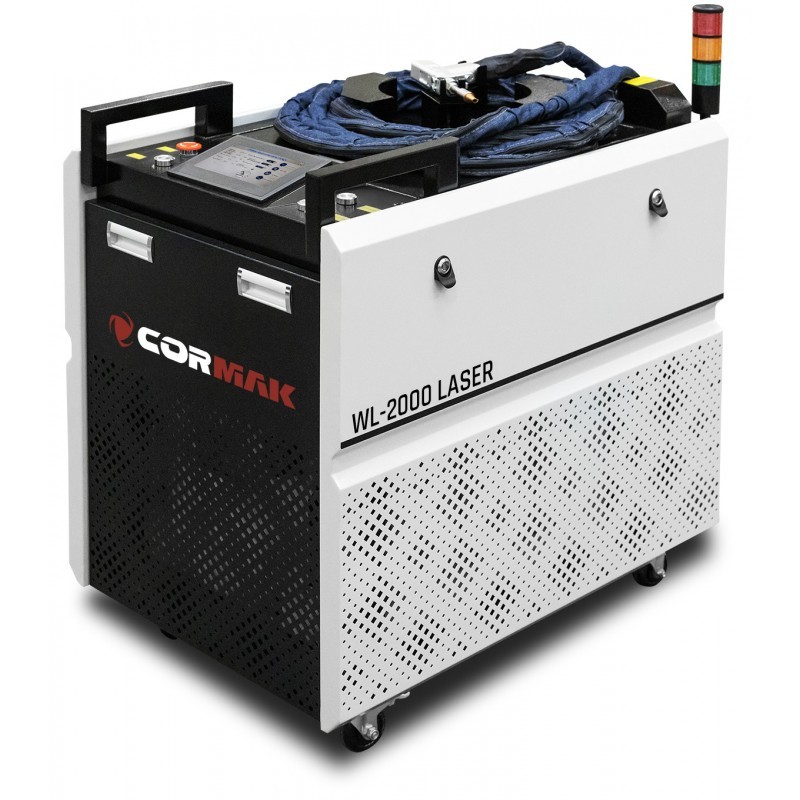
Laser welding of aluminium and stainless steel allows for the production of narrow, aesthetically pleasing and repeatable welds with limited heat input. However, the final result depends not only on the power of the machine. Equally important are surface preparation, the fit of the components, the shielding gas, the way the welding head is guided, and correctly verified process parameters.
Laser welding of aluminium and stainless steel allows for the production of narrow, aesthetically pleasing and repeatable welds with limited heat input. However, the end result depends not only on the power of the machine. Equally important are surface preparation, the fit between components, the shielding gas, the way the welding head is guided, and correctly verified process parameters.
This guide explains the differences between laser welding of aluminium and stainless steel, how to prepare the material, and what signs indicate that the settings need adjusting. The guidance provided is of a technical nature. Operating parameters should be determined through trials for the specific material, joint and equipment, in accordance with the manufacturer’s instructions and the procedures in force at the facility.
What is laser welding?
In the laser welding process, a concentrated beam of energy heats the material in the joint area to a temperature that allows a weld to form. Compared to many arc welding methods, a laser can create a narrow heat-affected zone and enable the process to be carried out quickly. In practice, this helps to minimise distortion, but does not automatically eliminate it – the result depends, amongst other things, on the component’s geometry, clamping, linear energy input and welding sequence.
A handheld laser welder typically allows adjustment of power, travel speed, beam oscillation width, focal position, shielding gas parameters and – depending on the equipment – filler wire feed. These settings should not be treated as independent of one another. Changing one parameter usually affects the penetration, weld width, temperature and gap tolerance.
Safety when working with a handheld laser welder
Laser welding requires a specially designed workstation and safety procedures. In systems with an exposed beam, hazards may include direct and reflected laser radiation, damage to eyes and skin, ignition of flammable materials, process fumes, hot metal and spatter.
- use eye protection suitable for the wavelength and parameters of the specific equipment;
- designate and mark out a controlled laser work zone; restrict access to unauthorised persons;
- use guards, interlocks, emergency stop buttons and safety features as specified by the manufacturer;
- ensure effective extraction of welding fumes and general ventilation;
- remove or secure flammable materials from the hazard zone;
- allow only trained operators to work and follow the machine’s operating instructions.
Process parameters should only be set once a safe workstation has been established. Correct settings are no substitute for operator protection or risk assessment.
Laser welding of aluminium – material preparation
Aluminium dissipates heat rapidly and forms a natural oxide layer. Aluminium oxide has different properties to the base material; therefore, contamination and oxide residues can impair process stability and increase the risk of porosity. The cleanliness of the joint is particularly important here.
Before starting work
- remove oil, grease, moisture, dust and machining residues;
- prepare the edges using a method appropriate for the specific alloy and as per the technical documentation;
- use brushes and tools intended exclusively for aluminium to avoid transferring contaminants;
- keep the filler wire clean, if used;
- position the components so that the joint gap falls within the process parameters.
The laser responds well to precise alignment. A gap that is too wide or uneven may lead to weld collapse, lack of continuity, or the need to use filler wire and a different beam guidance strategy.
Laser welding of stainless steel – material preparation
Stainless steel often produces very aesthetically pleasing laser welds, particularly in thin sheets and sections. However, it requires protection against iron contamination, appropriate gas shielding and heat input control to minimise discolouration and the impact on the surface’s corrosion resistance.
Best practice for preparation
- degrease the surface and remove dust, fingerprints and any residue from protective film;
- Use abrasive tools and brushes intended exclusively for stainless steel;
- avoid contact with contaminated workbenches, clamps and tools previously used on carbon steel;
- ensure secure clamping, particularly for thin sheets prone to buckling;
- after welding, assess the need for cleaning, pickling or passivation in accordance with the part’s requirements.
How should laser welder settings be selected?
There is no single set of parameters for aluminium or stainless steel. The settings are influenced by, amongst other things: the type and thickness of the material, the alloy grade, the joint design, the gap, the welding position, the power source output, the head characteristics, focusing, oscillation, the type of wire used and the shielding gas.
Key process parameters
| Parameter | Significance | Signs of settings being too low or insufficient | Symptoms of settings being too high or excessive |
|---|---|---|---|
| Laser power | Affects the amount of energy delivered to the joint | Lack of melt, unstable weld, incomplete fusion | Excessive melting, sagging, discolouration or distortion |
| Feed rate | Helps determine the linear energy | If the speed is too high: insufficient penetration | If the speed is too low: excessive heating and a wide weld |
| Oscillation width | Affects the width of the weld bead and the joint tolerance | Insufficient gap coverage or incomplete wetting of the edges | Excessively wide weld, excessive energy outside the joint axis |
| Focus position | Affects the energy distribution in the weld zone | Insufficient energy concentration at the required location | Excessive concentration or process instability depending on the configuration |
| Shielding gas | Protects the weld pool and the surrounding area | Oxidation, porosity, discolouration and an unstable weld surface | Turbulence may disrupt the shielding and draw in air |
The safest method of selection is to start with the equipment manufacturer’s specifications or an approved procedure, and then carry out tests on material of the same thickness and grade. Change the parameters one at a time, record the results and assess the weld pool, face, root, distortion and repeatability.
Aluminium versus stainless steel – selection guidelines
Aluminium usually requires a different energy balance to stainless steel of the same thickness, as it dissipates heat rapidly. Stainless steel is more prone to visual overheating and discolouration; therefore, controlling linear energy and the gas shield is of particular importance. Do not transfer a programme from one material to another without carrying out technical trials.
Common problems when laser welding aluminium
Weld porosity
Porosity may be caused by moisture, oil, contaminants, oxides, inadequate gas shielding or the properties of the specific alloy. Start by cleaning the material again, checking the filler materials and verifying the gas supply conditions.
Lack of penetration or lack of edge fusion
This may be caused by insufficient linear energy, excessive speed, incorrect focusing, an excessively wide gap, or incorrect head guidance. Corrections should be made gradually, after first checking the fit of the joint.
Excessive melting and weld collapse
This symptom may indicate that too much energy is being applied to the material, that the wire is being fed too slowly, or that the oscillation strategy is inappropriate. It is also worth assessing whether the joint geometry requires filler wire or a different edge preparation.
Cracks
Certain alloys and joint configurations are more prone to hot cracks. In such cases, simply adjusting the power is not sufficient. The material grade, delivery condition, joint configuration, filler material and welding procedure must be checked.
Common problems when laser welding stainless steel
Heat discolouration
Dark, blue or purple discolouration may indicate excessive heating, insufficient gas shielding or incorrect gas flow in relation to the weld area. Depending on the component’s requirements, subsequent chemical or mechanical cleaning, or passivation in accordance with the appropriate procedure, may be necessary.
Deformation of thin sheet metal
The laser usually limits heat input, but thin components may still deform. The following measures can help: appropriate clamping, the correct welding sequence, reducing the linear energy, and carrying out trials on a representative section of the workpiece.
Uneven or interrupted weld
The most common causes are contamination, a variable gap, unstable head guidance, worn consumables, or incorrect focus and gas settings. First, check the joint preparation; only then should you make major adjustments to the parameters.
Iron contamination of the surface
Contact with tools used for carbon steel can transfer iron particles to the stainless steel. In a corrosive environment, this can impair the appearance and resistance of the surface; therefore, keeping tools separate is part of good workshop practice.
Shielding gas and weld quality
Shielding gas helps to limit contact between the molten metal and the atmosphere. Argon is used in many applications; however, the selection of a specific gas, nozzle, direction of flow and flow rate should be based on the system’s instructions and the results of trials.
Too low a flow rate may impair shielding, whilst too high a flow rate does not always improve the result – it may cause turbulence and draw in ambient air. It is not only the flow rate that matters, but also the purity of the gas, the leak-tightness of the system, the condition of the hoses and the correct positioning of the nozzle relative to the weld pool.
Technical trials and quality control
Before commencing production, carry out a series of tests on material corresponding to the actual workpiece. The assessment should not be limited to the appearance of the surface. Depending on the requirements, it is also worth checking the penetration, cross-sectional geometry, any porosity, distortion and the strength of the joint.
- Prepare samples from the same grade and thickness of material.
- Degrease and prepare the surfaces in the same way as in production.
- Set the starting point in accordance with the equipment manual or procedure.
- Vary a single parameter and record the result.
- Assess the weld visually and using a method appropriate to the required quality.
- Only approve the settings once repeatable results have been achieved.
In quality-conscious production, it is advisable to develop or follow the appropriate technical instructions and process qualification guidelines required for the specific industry, customer or design.
When is a laser welding machine a good choice?
Laser technology works well in production where weld aesthetics, minimised distortion, repeatability and short processing times are important. It can be particularly useful for thin and medium-thickness, well-prepared joints and series of components with stable geometry.
However, it does not always replace TIG, MIG or MAG. For large gaps, very thick sections, specific material requirements or work in conditions that are difficult to control, the arc welding method may be more suitable or serve as a complement to the process. The choice should be based on a technical trial and the expected quality, rather than solely on the declared power of the equipment.
FAQ – frequently asked questions
Does aluminium require a higher power setting than stainless steel?
It often requires a different energy balance due to its high thermal conductivity, but settings cannot be determined solely on the basis of the material’s name. Thickness, alloy, gap, torch, speed and welding strategy are also decisive factors.
Is filler wire always required for aluminium welding?
Not always. The decision depends on the joint design, the gap, the desired weld geometry, the thickness and the quality requirements. Filler wire may be needed when it is necessary to fill the gap or achieve a specific weld shape.
Why does stainless steel change colour after laser welding?
Discolouration is usually related to heat energy and gas shielding. The purity, gas supply, head tracking and parameters should be checked. Depending on the intended use of the component, subsequent cleaning or passivation may be required.
Can settings be copied from another laser welder?
This should not be done without testing first. Differences in the laser source, head, optics, software, condition of consumables, gas and joint geometry can significantly alter the result.
Summary
Laser welding of aluminium and stainless steel can ensure high aesthetic quality and weld repeatability, but requires control over the entire process. Aluminium requires particular care to remove contaminants and oxides, whilst stainless steel requires protection against overheating, discolouration and iron contamination.
The most important factors are: a safe workstation, clean material, a stable fit, correctly selected gas, trial welds and the documentation of approved settings. Only by combining these elements can the full potential of a laser welder be realised in production.
