


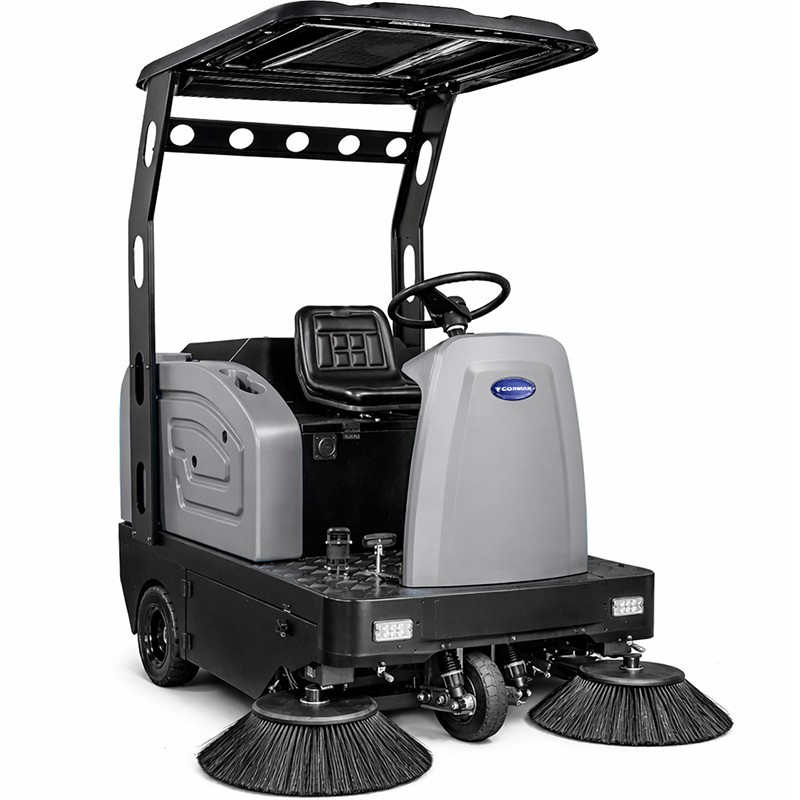
A ride-on sweeper can significantly improve cleaning efficiency in halls, warehouses, car parks and industrial sites. However, the results depend on the machine being properly suited to the surface, the type of dirt and the way the work is organised.
A ride-on sweeper can significantly improve cleaning efficiency in halls, warehouses, car parks and industrial sites. However, the results depend on the machine being properly matched to the surface, the type of dirt and the organisation of the work.
Many mistakes made when purchasing stem from comparing only the price or a single specification. Below, we outline the most common issues and provide practical tips to help you choose a sweeper that meets the actual needs of your premises.
Mistake 1: Mismatching the sweeper to the surface
One of the most common problems is buying a machine that looks good in the catalogue but is unsuitable for the conditions at the site. A sweeper that is too large may struggle in narrow aisles, whilst one that is too small will be ineffective in a large car park or open space.
What is the mistake?
Factors such as the actual working area, the layout of walkways and driveways, the number of obstacles, the width of passageways, the type of surface and the level of dirt are often overlooked when making a choice. These factors are more important than the machine’s stated performance alone.
How can this be avoided?
- measure not only the total area, but also the width of aisles, gates and passageways;
- determine whether the machine will mainly be used on concrete, tarmac, paving stones or uneven surfaces;
- assess the type of debris: dust, sand, leaves, packaging waste or fine production residues;
- on uneven surfaces, check the suspension, ground clearance and the ability to adjust brush pressure;
- for open areas, analyse the working width, and for confined spaces – the manoeuvrability and overall dimensions of the machine.
Mistake 2: Incorrect choice of drive system
The type of drive system affects the application, work organisation, maintenance requirements and operator comfort. There is no single solution suitable for every site.
What is the mistake?
It is a mistake to choose a sweeper with an internal combustion engine for an enclosed, poorly ventilated hall, or to purchase a battery-powered model without checking whether the available operating time and charging infrastructure match the planned work shifts.
How can this be avoided?
- For halls, warehouses and other indoor spaces, usually opt for battery-powered models, which produce no local exhaust emissions;
- consider petrol-powered models primarily for outdoor areas or well-ventilated spaces;
- compare the actual operating time per charge, charging time and the method of battery replacement or maintenance;
- for combustion-engine models, take into account fuel availability, engine maintenance, noise levels and ventilation conditions;
- choose the power source based on your cleaning schedule, not solely on the purchase price.
Mistake 3: Ignoring actual performance
Performance specified in m²/h is an important parameter, but it usually reflects theoretical capabilities. In practice, it is affected by turning, navigating around obstacles, manoeuvring, the time taken to empty the tank and the degree of soiling.
What is the mistake?
A company buys a machine with too narrow a working width or too small a dustbin capacity, and it then turns out that cleaning takes too long and interferes with warehouse or production operations.
How can this be avoided?
- compare the stated performance with the actual cleaning route;
- check the width of the main brush and the working width including the side brushes;
- take into account the time needed for travel, turning round, emptying the dustbin and daily maintenance;
- choose a machine with a reasonable margin of capacity, rather than constantly operating at the limits of its specifications;
- ask to test the machine at your premises or watch a demonstration on a similar surface.
Mistake 4: overlooking running costs
The purchase price is only part of the cost of owning a sweeper. In day-to-day operation, brushes, filters, drivetrain components and batteries wear out. Servicing and downtime for maintenance are also significant factors.
What is the mistake?
Buying the cheapest model without checking the prices of spare parts and the availability of servicing may result in higher costs over the machine’s entire service life, as well as problems keeping the machine operational.
How can this be avoided?
- compare the prices and availability of brushes, filters, batteries, tyres and other consumable parts;
- check the warranty cover, the location of the service centre and the typical lead time for parts;
- ask about the recommended daily, weekly and periodic maintenance tasks;
- take into account the cost of energy or fuel, as well as the time spent on charging and servicing;
- assess the purchase in terms of the total cost of ownership, rather than just the initial price.
Mistake 5: failing to analyse operator comfort and safety
A ride-on sweeper is often used for many hours a day. The ergonomics of the operator’s station and visibility have a direct impact on the pace, consistency and safe performance of the work.
What is the mistake?
A choice based solely on technical specifications may overlook the quality of the seat, the layout of the controls, visibility of the working area, ease of getting on and off, or access to daily maintenance points.
How can this be avoided?
- check the operator’s position, seat adjustment and accessibility of all controls;
- assess visibility in front of the machine, to the sides and when reversing;
- compare the turning circle and ease of manoeuvring in congested areas;
- verify the operation of the brakes, warning signals and safety features;
- ensure operators receive training and that daily machine inspection procedures are followed before starting work.
Mistake 6: Incorrectly selected waste container capacity
The waste hopper should be appropriate for both the area to be covered and the volume of waste to be collected. If it is too small, it will necessitate frequent breaks, whilst if it is too large, it may unnecessarily increase the machine’s dimensions, weight and cost.
What is the mistake?
When making the selection, only the area is taken into account, without analysing the type of debris. For example, light dust and sand have a completely different volume and weight to leaves, packaging waste or mixed debris from an outdoor site.
How can this be avoided?
- determine how often the machine will be in operation and where the hopper can be safely emptied;
- take into account the type and volume of debris found on the premises;
- check the emptying method: manual, mechanical or by lifting to a greater height;
- assess the tank capacity in conjunction with the working width and the planned working route.
Mistake 7: Overlooking features that are important for a given site
Not every additional feature is essential, but some are of great importance for safety and efficiency in specific working conditions.
What is the mistake?
Choosing a basic configuration without analysing filtration, dust extraction, brush adjustment, operation on slopes or warning equipment may limit the machine’s usability upon delivery.
How can this be avoided?
- in high-dust environments, pay attention to the dust extraction system, filtration parameters and how easy the filters are to clean;
- on uneven surfaces, check the brush adjustment and the durability of the working parts;
- in busy areas, consider work lighting, warning signals and equipment to improve visibility;
- when working outdoors, take into account weather conditions, the type of surface and access for servicing;
- select filters and equipment strictly in accordance with the intended use specified by the manufacturer of the relevant model.
Mistake 8: focusing solely on the purchase price
The lowest price does not always mean the lowest running cost. Differences in durability, component quality, service availability and performance parameters may be more significant than the initial saving.
What is the mistake?
A company buys a machine without comparing warranty terms, spare parts, standard equipment, actual performance and suitability for the site. After a while, costs arise from repairs, downtime or the need to purchase a second machine.
How can this be avoided?
- compare machines with similar working widths, drive types and intended uses;
- check exactly what is included in the standard equipment;
- assess build quality, service availability and parts availability;
- ask for a running-cost estimate and a recommendation for a specific area;
- take into account not only the purchase price, but also operating time, downtime and maintenance costs.
Checklist before purchasing a ride-on sweeper
Before making a decision, it is worth answering a few specific questions:
- What area needs to be cleaned during a single shift?
- Is the work carried out indoors, outdoors or in both environments?
- What types of surfaces and debris are involved?
- How wide are the aisles, gates and passageways?
- How often does the tank need to be emptied, and where will this be done?
- How long is the operating time required without recharging or refuelling?
- Are special functions required at the site, such as dust extraction, warning systems or operation on uneven surfaces?
- What is the availability of servicing and consumable parts?
Summary
The best ride-on sweeper is not simply the largest, most powerful or cheapest. It should be suited to the surface area, the type of debris, the intended use and the company’s servicing capabilities.
A careful analysis before purchase helps minimise the risk of insufficient performance, unnecessary downtime and excessive running costs. It is worth comparing several models, testing them in conditions similar to real-world use, and choosing a solution that will improve cleaning efficiency in the long term.
