


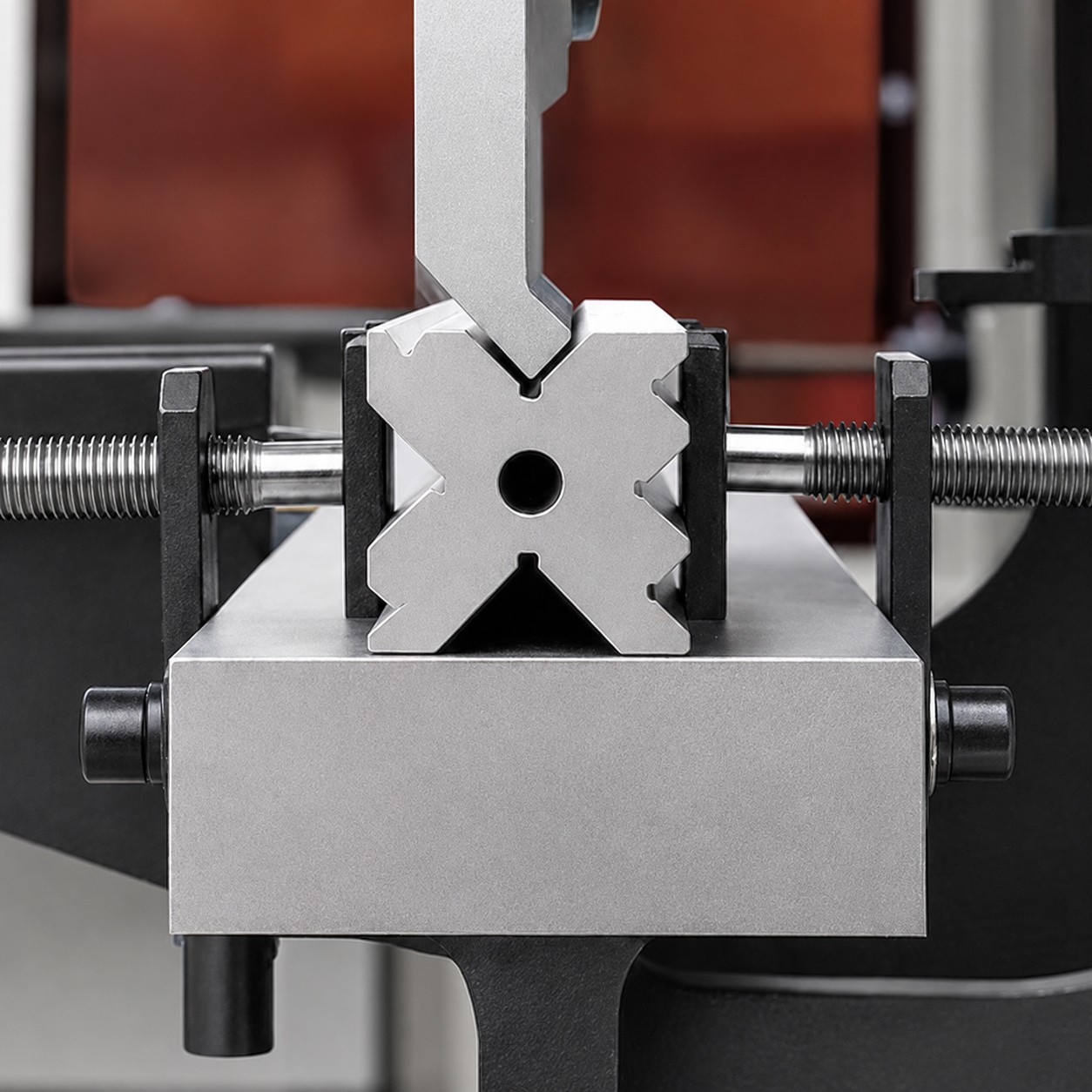
Dies for press brakes are one of the most important components in the sheet metal bending process. They work in direct conjunction with the punch to form the tooling assembly responsible for shaping the material.
Die sets for press brakes are one of the most important components in the sheet metal bending process. They work directly with the punch to form the tooling assembly responsible for shaping the material.
Every modern press brake, particularly a CNC press brake, requires tools selected to suit the material, the workpiece geometry and the process parameters. Without the correct die, even a sophisticated machine will not deliver the expected quality or repeatability of the bend.
What are press brake dies?
A press brake die is the lower working tool that supports the sheet metal during forming. During bending, the punch presses the material into the die groove, and the way they fit together determines the resulting angle, radius and surface quality of the workpiece.
A die is not a universal component suitable for every task. Its geometry, groove width, angle and clamping system should be tailored to the specific material and the intended operation. A properly selected set comprising the punch, die and machine parameters helps to maintain process stability.
The importance of dies in the bending process
In any bending process, proper support of the material is of key importance. It is the die that largely influences the positioning of the sheet metal and the course of its deformation.
A well-chosen die helps to control:
- the bending angle;
- the bending radius;
- the stability of the material during operation;
- the surface quality of the workpiece;
- the repeatability of results across successive cycles.
In metalworking workshops, this has a direct impact on product quality, scrap rates and order fulfilment times.
Types of dies for press brakes
V-dies
V-die sets are among the most commonly used solutions in standard sheet metal bending operations. Their design is well-suited to many typical applications, particularly in free-bending.
Multi-groove dies
Multi-groove dies have several grooves of varying widths. They make it easier to select the appropriate groove for the material thickness without frequent changeovers, which can streamline work on varied orders.
U-die
U-dies are used in more advanced operations where greater forming depth or a specific profile geometry is required.
Specialised dies
Specialist dies are designed for specific technological applications, for example for:
- complex bending processes;
- the production of non-standard components;
- precision multi-stage bends;
- parts with unusual cross-sections or embossings.
How to select the right die?
Selecting the right die for a CNC press brake is one of the most important stages in preparing the process. It is worth taking into account not only the dimensions of the tool, but also the properties of the material and the requirements for the finished component.
Material thickness
The width of the die groove must be matched to the thickness of the sheet metal. This affects the way the material is deformed, the required pressure and the quality of the bend obtained.
Type of material
Aluminium, stainless steel and structural steel differ in their mechanical properties and behaviour during bending. The material may require a different radius, tool angle or process settings.
Pressure force
The die should be selected to match the machine’s operating parameters and the anticipated pressure force. The bend length, material thickness and strength of the tooling used must also be taken into account.
Bending angle and radius
Incorrect matching of the die geometry to the required angle and radius may result in inaccuracies, surface marks or an increased risk of material damage.
Tool compatibility
The punch and die must form a correctly matched set. Before starting work, it is also worth checking the compatibility of the clamping system with the press, as well as any limitations arising from the workpiece’s geometry.
CNC press brakes and CNC technology
Modern press brakes utilise CNC (Computer Numerical Control) systems, which allow key process parameters to be programmed and controlled. Among other things, the operator can set the position of the stops, the beam movement, the bending depth and the sequence of operations.
The use of CNC in bending processes facilitates:
- control of process settings;
- repeatable, precise bending;
- reducing the risk of errors during production;
- more efficient organisation of the operator’s work;
- better utilisation of the machine fleet.
CNC technology is now standard in companies that carry out both single-piece production and repetitive series production of metal components.
The impact of dies on production efficiency
Carefully selected dies affect not only the quality of individual parts, but also the organisation of the entire process. Well-matched tools help to reduce the number of trial bends, corrections and unplanned downtime.
In practice, this can mean:
- a reduction in operation lead times;
- fewer interruptions due to changeovers;
- a reduction in waste;
- improved quality and repeatability of parts;
- better utilisation of the available machine.
The most common errors in die selection
When working on press brakes, problems often arise from incorrect tool selection, machine settings or failure to take material properties into account. The most common issues include:
- material fractures;
- incorrect bending angles;
- deformation of sheet metal;
- surface damage;
- insufficient repeatability between parts.
It is therefore important for the operator to have experience and knowledge of bending technology, and to carry out trials before commencing mass production.
Maintenance and service life of dies
Regular inspection and proper maintenance help to maintain consistent quality and extend the service life of the tools. The basic principles include:
- cleaning the tools after use;
- checking the technical condition, wear and any damage;
- storing them in dry, secure conditions;
- avoiding overloading and operating outside the permissible parameters;
- correct assembly and careful handling of tools during replacement.
Well-maintained punches and dies support process stability and help maintain the expected production quality.
V-die versus multi-groove die – a comparison
| Feature | V-die | Multi-groove die |
|---|---|---|
| Type of application | Standard bending operations | Working with materials of varying thicknesses |
| Number of grooves | One working groove | Multiple grooves of varying widths |
| Flexibility | Good for typical tasks | Greater with a varied range of workpieces |
| Set-up | May require tool replacement | May reduce the need for frequent die changes |
Summary
Dies for press brakes are an indispensable part of the sheet metal bending process. When combined with a suitably selected punch and the capabilities of a CNC press brake, they enable high precision and repeatability.
Modern CNC technology, a well-planned machine tool fleet and tools tailored to the application form the basis of modern metalworking. The correct selection, operation and maintenance of dies help to build an efficient and stable production process.
