

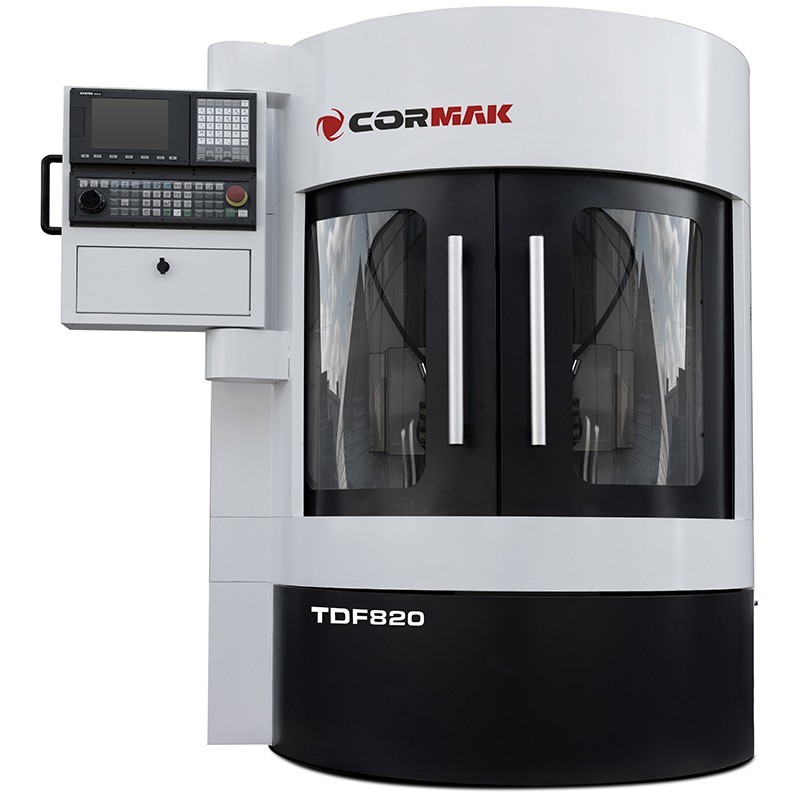
A wheel lathe is a specialised machine used in the restoration of aluminium wheels. It enables the surface of the wheel to be precisely restored, including the diamond-cut finish, provided the condition of the component and the scope of the machining allow for this. Professional workshops primarily use CNC lathes with touchscreens, which ensure repeatability, accuracy and efficient process management.
A wheel lathe is a specialised machine used in the refurbishment of alloy wheels. It allows the surface of the wheel to be precisely restored, including a diamond-cut finish, provided the condition of the wheel and the scope of the work permit this. Professional workshops primarily use CNC lathes with touchscreens, which ensure repeatability, accuracy and efficient process management.
It is worth bearing in mind that turning is not a suitable method for repairing every type of damage. Rims with cracks, severe deformation or insufficient material thickness should be assessed by a qualified service centre in accordance with the manufacturer’s recommendations and safety requirements.
A wheel lathe – what is it and why is it essential in a workshop?
A wheel lathe is a machine designed for the precise machining of wheel rims, most commonly aluminium ones. Its function is to remove a very thin, controlled layer of material in order to eliminate signs of wear, minor scratches or surface damage. It is a vital component of a wheel refurbishment workstation, particularly where the workshop handles wheels with a machined or diamond-cut finish.
Modern CNC solutions help to minimise the risk of positioning errors and ensure a high degree of machining repeatability. However, they are no substitute for a proper assessment of the rim’s condition, correct clamping or the operator’s expertise.
How does a CNC wheel lathe work?
A CNC lathe operates on the basis of a control programme that determines the tool’s position and the machining sequence. This allows machining to be carried out with a high degree of repeatability, particularly when refurbishing the front face of a wheel rim.
- Wheel mounting: the wheel is securely clamped in the machine’s chuck.
- Setting the axes and parameters: the operator sets the position of the rim and the machining parameters, including the reference to the machine’s axes.
- Surface measurement or scanning: on selected models, the system can support surface profile analysis and the detection of irregularities.
- Machining: the tool removes a minimal, pre-programmed layer of material, restoring the surface in accordance with the set profile.
- Preparation for finishing: after turning, the wheel may require a protective coating, painting or polishing – depending on the refurbishment technology.
Step-by-step aluminium wheel refurbishment
Professional wheel refurbishment should begin with an assessment of its condition. The scope of work depends on the type of damage, the rim’s construction, the surface finish and the permissible amount of material that can be removed.
- Initial assessment and safety check: checking for cracks, deformation, corrosion and the overall condition of the wheel.
- Cleaning: removal of dirt, deposits and operational residues.
- Removal of the old coating: preparing the surface for repair and further treatment.
- Repair of permissible damage: any necessary work should be carried out by an experienced service centre in accordance with safety requirements.
- CNC machining: precise restoration of the rim’s surface within the permissible machining limits.
- Finishing: painting, polishing or other protective treatment appropriate for the specific type of wheel.
- Quality control: assessment of appearance, geometry and finish quality before the wheel is released for use.
A properly planned process can restore the aesthetic appearance of the rims, but should not compromise their safety or structural parameters.
Touchscreen wheel lathe – modernity and convenience
The touchscreen makes it easier for the operator to access settings, programmes and a preview of process parameters. Depending on the model, it may also support visualisation of the machining process, profile selection and guidance through the successive stages of configuration.
- more intuitive operation and shorter set-up times;
- clear overview of process data;
- easier selection of saved programmes and profiles;
- lower risk of errors when entering settings manually.
Operating a CNC machine still requires training and knowledge of safe machining practices. A touchscreen interface can make the work easier, but it is no substitute for the operator’s experience.
Why is it worth investing in a wheel lathe?
A CNC wheel lathe can expand a workshop’s range of services to include precision wheel refurbishment. For businesses operating in the tyre, detailing, paintwork or car servicing sectors, this means being able to carry out a larger proportion of the service in-house.
- a wider range of services: wheel refurbishment can complement existing workshop services;
- greater control over deadlines: fewer stages need to be outsourced;
- Consistent results: CNC control supports process standardisation;
- potential for growth: the machine can support the servicing of individual customers, fleets and business partners.
CNC lathe versus traditional lathe – which to choose?
| Feature | Manual lathe | CNC wheel lathe |
|---|---|---|
| Precision and repeatability | Depends largely on the operator’s experience | High, provided the correct programme and settings are used |
| Operation | Requires manual supervision of the process | Supported by the control system and saved settings |
| Automation | Limited | Possible to a degree depending on the model |
| Performance | Depends on the operator and the type of work | Better repeatability in batch production |
If the aim is to develop a wheel refurbishment service and improve the repeatability of the work, a CNC lathe is usually the more practical solution. The final choice should take into account order volume, available space, the team’s skills and the planned scope of services.
What should you look out for when buying a wheel lathe?
- the range of rim diameters and widths supported – this should match the workshop’s order profile;
- Control axes and positioning accuracy – these affect the quality of machining;
- clamping and measuring system – this should ensure stable, repeatable wheel positioning;
- touchscreen and ease of programming – these are important for the ergonomics of day-to-day work;
- Profile scanning or copying functions – available depending on the machine’s specifications;
- service, training and spare parts – important for the continuity of the workstation’s operation;
- safety and installation requirements – must be verified before commissioning the machine.
Why do customers seek wheel refurbishment?
Car owners often search for services using terms such as ‘alloy wheel refurbishment’, ‘wheel repair’, ‘CNC wheel lathe’ or ‘wheels as good as new’. A well-described service, photos of completed work and clear information on the scope of work help the workshop to respond to this purchasing intent.
Is a wheel lathe a worthwhile investment?
The profitability of the investment depends on the number of jobs, service prices in the region, machine utilisation, labour costs, consumables, maintenance and how the service is marketed. A wheel lathe may be of particular interest to a tyre repair workshop, a car detailing company or a service centre looking to expand its offering to include wheel refurbishment.
Before purchasing, it is worth carrying out a simple analysis: the expected monthly volume of orders, the average value of the service, fixed and variable costs, and a plan for using the machine. This allows for a realistic assessment of the payback period for a specific business.
FAQ – frequently asked questions
Can any wheel be refurbished on a lathe?
No. Rims with cracks, significant deformations, advanced corrosion or insufficient material thickness may not be suitable for refurbishment. Each case requires an assessment of its technical condition.
How long does it take to refurbish a wheel rim?
The time depends on the type of wheel, the extent of the damage, the finishing technology and the workshop’s workload. The turning process itself is just one stage of the whole process.
Is a CNC lathe difficult to operate?
The CNC system and touch screen can make the work easier, but safe and repeatable machining requires training, correct wheel clamping and knowledge of the technology.
Does an investment in a CNC lathe pay for itself quickly?
This depends on the actual demand for the service, the machine’s utilisation rate and operating costs. It is best to assess profitability based on your own sales plan and cost estimate.
Summary
A wheel lathe, particularly a CNC lathe with a touchscreen, can be a key component of a professional aluminium wheel refurbishment workstation. It facilitates precise, repeatable surface machining and supports the development of workshop services.
However, the best results depend on correctly assessing which rims are suitable for refurbishment, a safe process, a well-chosen machine and the operator’s expertise. Before purchasing, it is worth comparing the machine’s specifications with your actual service profile and planned workload.
