


Machine threading is one of the fundamental operations in metalworking, used wherever fast and precise screw connections are required. The use of modern numerically controlled systems means that CNC threading is characterised by repeatability, process stability and the ability to machine a wide range of materials – from structural steel to aluminium alloys.
Machine threading is one of the fundamental operations in metalworking, used wherever fast and precise screw connections are required. The use of modern numerically controlled systems means that CNC threading is characterised by repeatability, process stability and the ability to machine a wide range of materials – from structural steel to aluminium alloys.
- The method of threading on a CNC lathe
- Thread cutting on a CNC milling machine
- What are the parameters of machine threading?
- Professional threading tools and equipment from Cormak
Thread cutting method on a CNC lathe
Thread cutting on a CNC lathe is a method that allows for the production of external and internal threads with very high geometric accuracy. Machine tools such as CNC lathes enable the synchronisation of spindle movement with tool feed, which results in a perfect reproduction of the thread profile. In practice, threading on a lathe is used for cylindrical components: sleeves, shafts, hydraulic components and precision fittings.
Thread cutting on a CNC milling machine
Where it is necessary to produce threads in flat or three-dimensional components, threading on a CNC milling machine is used. Modern CNC milling machines allow for threading using the interpolation method – a process characterised by very low cutting forces and high tool life. Thread cutting on a milling machine is also gaining popularity due to the ability to machine partial, tapered and special threads, which are difficult to produce using conventional methods.
What are the parameters of machine threading?
To obtain a thread with the correct geometry, it is necessary to correctly select elements such as:
- tool rotational speed,
- feed rate (precisely related to the thread pitch),
- cutting depth and machining strategy,
- the type of coolant and its pressure.
These factors determine not only the tool’s service life, but also the stability of the process and the quality of the final thread. Therefore, machine threading parameters are selected individually for the material and thread type.
Appropriately selected machining strategies ensure that the threading process remains stable even when working with difficult-to-machine materials. Combined with advanced CNC machines, this allows high-quality threads to be achieved with minimal operator intervention.
Professional threading tools and equipment from Cormak
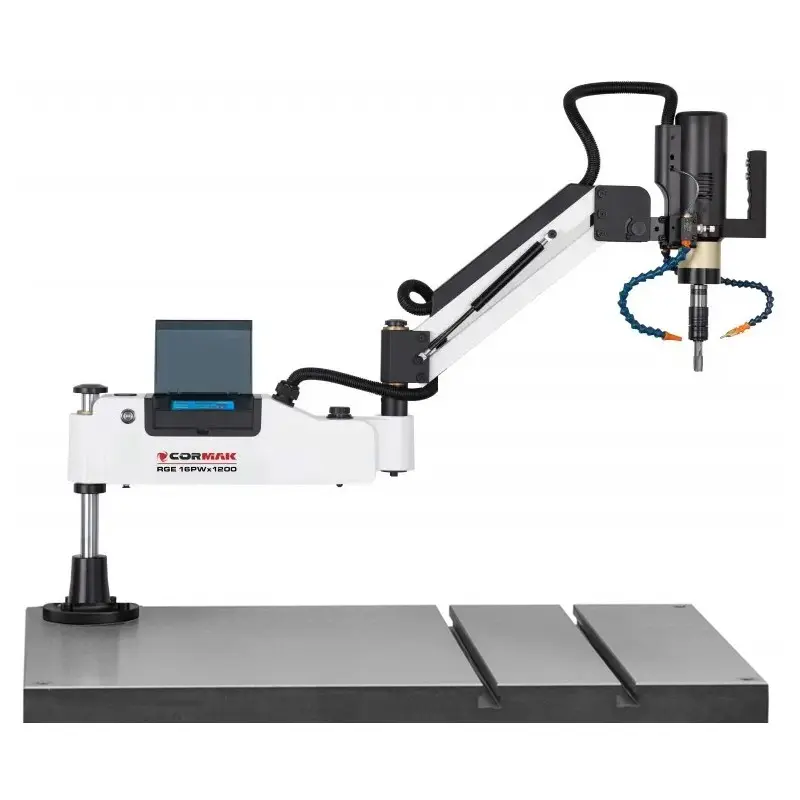
The right choice of equipment is of paramount importance in manufacturing processes. Cormak – a manufacturer of industrial machinery – offers a complete range of threading tools, including taps, heads, threading cutters and holders. For facilities requiring flexibility and ergonomics, a threading arm is also available, enabling the rapid production of threads in small and medium-sized batches.
CNC machine threading is a process which, thanks to its precision and automation, significantly improves production quality and reduces machining time. Properly configured lathes, milling machines and other metalworking machines, combined with the right parameters and professional tools, ensure that even the most demanding threads can be produced quickly, consistently and cost-effectively.
