

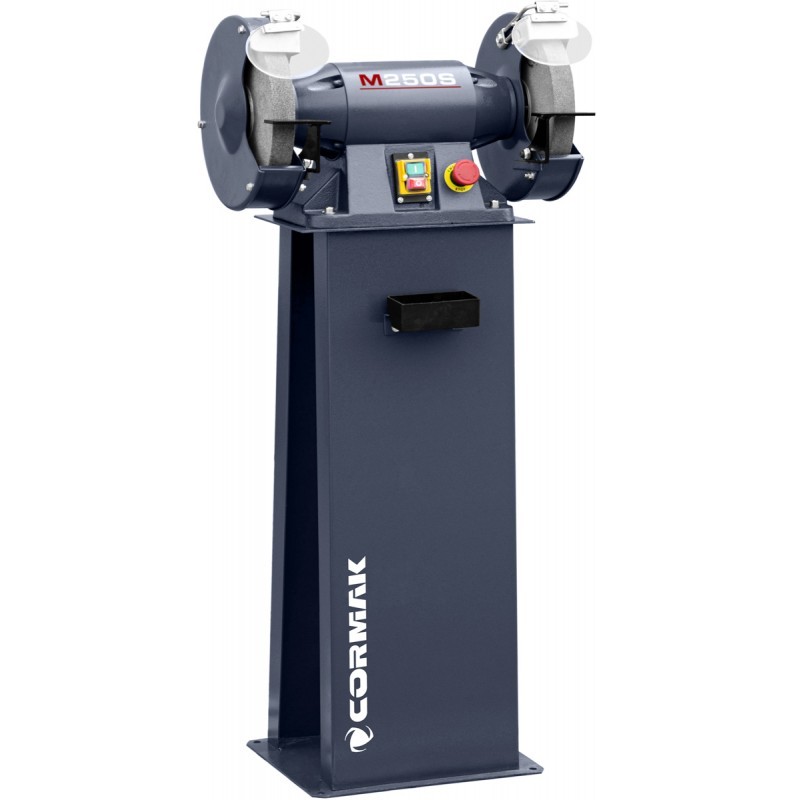
Industrial double-wheel grinders for metal are used for deburring, sharpening tools, removing excess material and preparing surfaces for further machining. Explore their applications, compare the CORMAK M200S, M250S and M300S models, and learn how to select and maintain an industrial grinder.
Industrial double-wheel grinders for metal are an important part of the equipment used in manufacturing facilities, toolrooms and mechanical workshops. They enable operators to remove burrs, sharpen tools, chamfer edges and smooth localised areas of surfaces. Appropriately selected grinding wheel machines help prepare workpieces for subsequent production stages.
Characteristics of industrial double-wheel grinders
The double-wheel design allows two grinding wheels with different grit sizes to be used without changing them between operations. Coarser grit facilitates material removal, whilst finer grit enables a more accurate finish. The CORMAK M200S is equipped with plastic shields against sparks and flying particles, together with a straightforward control panel.
- Powerful motor: Suitable motor power helps maintain grinding performance under load.
- Durable construction: A stable pedestal and robust construction reduce unwanted vibrations during operation.
- Versatility: Selecting compatible grinding wheels allows the machine to be adapted to the material, required accuracy and type of operation.
Industrial applications of double-wheel grinders
Double-wheel grinders are used in both series production and individual workshop operations:
- Machinery manufacturing: Deburring components, preparing edges and sharpening tools used for assembly.
- Automotive industry: Removing burrs from small components and carrying out maintenance work. Precision machining of shafts and brake discs requires specialised machinery.
- Aerospace industry: Auxiliary finishing and tooling operations performed in accordance with the process requirements of the particular component.
How to choose a double-wheel grinder for metal
When selecting a machine, consider its motor power under S1 duty, rotational speed, grinding wheel diameter and width, workpiece material, intensity of use and available safety features. Compatibility with the facility's electrical installation is also important.
The CORMAK M200S is suitable for typical workshop operations. The CORMAK M250S offers a larger grinding wheel diameter at the same S1 power rating. The CORMAK M300S provides higher motor power and larger, wider grinding wheels, which should be considered for more intensive machining tasks.
| Model | Grinding wheel dimensions | S1 power | Rotational speed |
|---|---|---|---|
| M200S | 200 × 32 mm | 0.9 kW | 2960 rpm |
| M250S | 250 × 32 mm | 0.9 kW | 2960 rpm |
| M300S | 300 × 50 mm | 2.2 kW | 1450 rpm |
All three models have a catalogue-rated 400 V power supply and K36/K60 grinding wheel grit sizes. S1 denotes motor power under continuous duty. It should not be equated with the S6 power rating, which refers to a specific periodic duty type.
Double-wheel grinder safety and maintenance
When grinding, use the machine guards, suitable eye and face protection, and follow the manufacturer's instructions. Never exceed the permissible wheel speed or grind on the side of a wheel unless it is designed for that purpose. A suitable extraction system limits the spread of contaminants. An example of a complete workstation is the CORMAK M300S with MDC750 400 V extractor. Check that the extraction system is suitable for the dust generated by the material, particularly where combustible dust is involved.
Regular maintenance helps keep the machine in working order and reduce unplanned downtime:
- Cleaning: After disconnecting the power supply, remove contaminants in accordance with the instructions and check the extraction system for obstructions.
- Grinding wheel inspection: Check the condition, wear and mounting of the wheels. Replace damaged wheels and dress their working surfaces where permitted.
- Technical inspections: Regularly inspect guards, work rests, fastenings, power cables and the drive system. Carry out adjustments with the machine stopped and disconnected from the power supply.
Summary
An industrial double-wheel grinder for metal enables numerous auxiliary and finishing operations to be carried out efficiently. Selecting suitable motor power, grinding wheels and protective equipment, together with regular maintenance, helps achieve consistent machining quality and safe working practices. Explore the CORMAK range and choose the model that meets your facility's requirements.
