

What equipment is essential in a woodworking workshop? One such essential item is a sawdust cyclone – it ensures the effective separation of sawdust and dust from the air, which not only improves working conditions but also extends the service life of the machinery. In this article, we explain how a cyclone is constructed, how it works, and why it is worth investing in an effective dust extraction system for your workshop.
A sawdust cyclone is a device designed to effectively separate contaminants generated during woodworking. Sawdust, shavings and dust are a natural by-product of cutting, milling or sanding, but their accumulation can lead to machine breakdowns, increased wear and tear on components, as well as a deterioration in working conditions and air quality. The cyclone utilises centrifugal force to separate solid particles from the air stream, thereby protecting the extraction system, reducing the risk of filter blockages and improving the overall efficiency of the dust extraction system. Modern designs based on negative pressure technology can handle not only dry sawdust but also damp material, which increases their versatility in various operating conditions.
In this article:
- Sawdust cyclone – design
- How a sawdust cyclone works
- Where are sawdust extraction systems suitable?
- Why is it worth investing in a dust extraction system in a workshop?
- Summary
Sawdust cyclone – construction
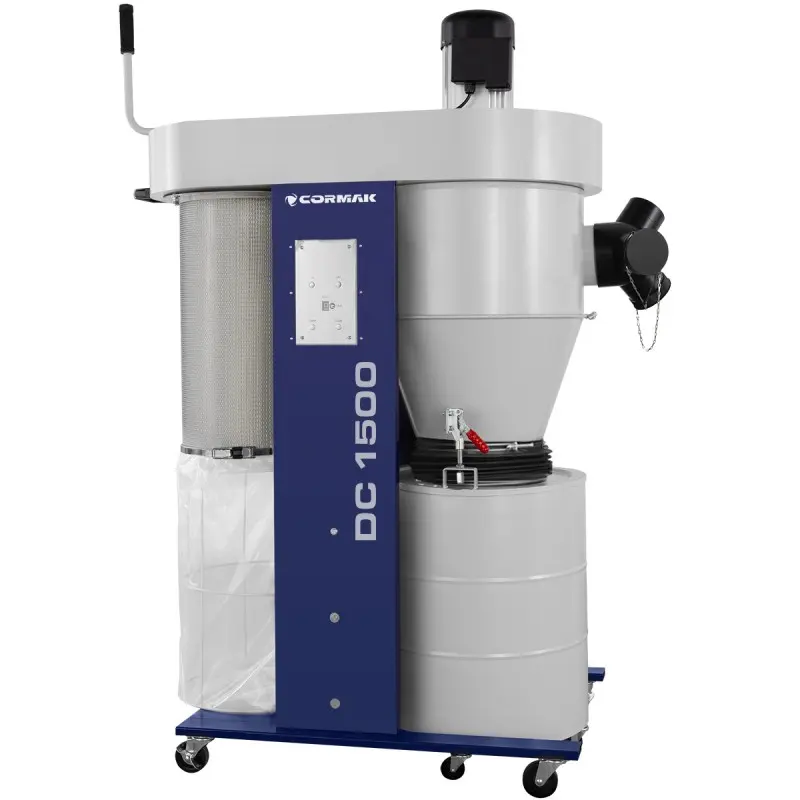
What exactly does a sawdust cyclone consist of? The design of this device is based on a structure that enables the separation of solid particles through the process of air centrifugation. Its main components are:
- inlet chamber – the point where air containing sawdust enters the device. The design ensures the correct airflow pattern, enabling the separation process to begin;
- conical body – this is where the key stage of separating solid particles takes place. The conical shape of the body intensifies the centrifugal motion, enabling effective dust separation;
- outlet duct for purified air – the component responsible for discharging the filtered air;
- sawdust and dust collection tank – the compartment where waste separated from the air is collected.
The design of the sawdust cyclone ensures maximum separation efficiency whilst maintaining the durability of the unit.
How a sawdust cyclone works
To better understand how a sawdust cyclone works, it is worth looking at the processes taking place inside its chamber. Contaminated air enters the side or tangential inlet, where it is set in intense rotational motion. The resulting vortex generates a strong centrifugal force, which pushes the heavier particles – sawdust, shavings and dust – towards the walls of the conical body. There, they lose speed and fall by gravity into the lower hopper or sump. The cleaned air, stripped of most solid particles, is directed upwards and discharged through the central outlet duct.
The use of high-vacuum radial fans ensures that separation takes place quickly and with high efficiency. Cyclones effectively capture particles larger than 5 µm, making them ideal for woodworking facilities where the volume and variety of waste are significant. Combined with sawdust extraction systems, they form an efficient dust extraction system that protects the equipment, reduces the risk of filter clogging and improves working conditions throughout the workshop
Where are sawdust extractors suitable?
Sawdust extractors are used wherever large quantities of shavings, sawdust and dust are generated during woodworking. They are essential in both small joinery workshops and larger production facilities, as they keep the workstation clean, protect machinery from clogging and improve worker safety. They work best with equipment that generates a heavy flow of waste, such as circular and panel saws, bottom-spindle moulders, planers, thicknessers, jointer-planers, belt and drum sanders, wood lathes and CNC machines. In each of these cases, the extraction system ensures consistent removal of contaminants at source, which significantly increases work efficiency and the service life of the machinery.
Why is it worth investing in a dust extraction system for your workshop?
An effective dust extraction system in a workshop is an investment that brings tangible benefits on many levels, both technical and economic. Above all, sawdust extractors protect workers’ health. Inhaling fine dust particles over a prolonged period can lead to serious respiratory diseases, which in turn increases staff absenteeism. A dust extraction system helps avoid such problems whilst improving staff productivity.
Dust extraction extends the service life of woodworking machinery, tools and accessories by reducing wear and tear through the prevention of dust and shavings accumulating in critical parts of the mechanisms. As a result, the workshop can save on maintenance costs and the replacement of consumable parts. Furthermore, the use of equipment such as a sawdust cyclone contributes to better work organisation by eliminating the problem of accumulated sawdust.
Another advantage is the protection of the final product’s quality – precision woodworking requires a clean working environment, free from airborne dust particles that may settle on the surfaces being worked on.
Summary
A sawdust cyclone is an essential piece of equipment in modern joinery workshops. Thanks to their well-thought-out design and effective operating principle, cyclones form the foundation of dust extraction systems. Their design allows for the separation of solid particles, protecting woodworking machinery and improving air quality. Combining them with equipment such as sawdust extraction systems provides a comprehensive solution for workshops of all sizes.
As an experienced manufacturer of industrial machinery, CORMAK offers cyclone extractors for wet and dry sawdust, tailored to the needs of facilities of various sizes. These products are characterised by robust materials and precision engineering. They are equipped with radial fans capable of generating very high vacuum pressure. We encourage you to explore the full range of these products, and if you have any questions, please do not hesitate to contact us. Our specialists will be happy to assist you in selecting the right equipment.
