

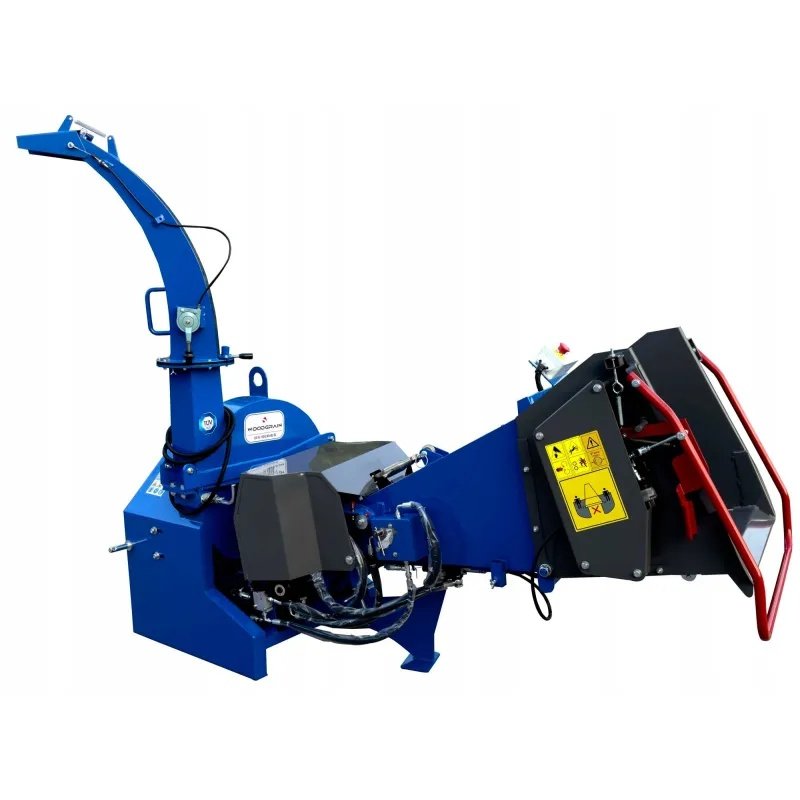
A professional wood chipper should match the timber, material volume and working arrangements. Learn why branch diameter, feed system, blades and mobility matter. Compare drum and disc designs and understand the factors that affect both the purchase price and the machine's ongoing operating costs.
Which professional wood chipper should you choose?
A professional wood chipper should match the timber type, waste volume and the company's working arrangements. A farm clearing an orchard has different requirements from a team regularly handling tree-felling jobs. Before purchasing, compare not only power and maximum material diameter, but also feeding, cutting-system design, mobility and running costs.
Key specifications of a wood chipper
Start by identifying the material that will be processed most frequently. Fresh branches, dry limbs, hardwood and felling residues differ in diameter, moisture content, hardness and branching. The machine must be selected for the actual working conditions, rather than solely for the highest figure in a catalogue.
Maximum chipping diameter is not the same as the size of the feed opening. A wide hopper makes branched material easier to introduce, but does not mean that the cutting system can process equally thick timber. Before purchasing, check the permitted material dimensions and the conditions to which the manufacturer's capacity figures apply.
Material feeding and actual productivity
Smooth branch feeding is important during intensive operation. On machines with powered feed rollers, check feed adjustment and the reverse function. Overall workstation productivity also depends on material preparation, staffing, interruptions and chip collection. Instantaneous cutting capacity should not be confused with the output achieved over a complete shift.
Blades, wear parts and servicing
Check the design of the blades and other working components, whether they can be sharpened or replaced, and the availability of parts. Access during inspections matters too. Blade maintenance and clearance adjustment should follow the manufacturer's documentation. Ease of maintenance affects downtime and the total cost of ownership.
Drum or disc chipper – which should you choose?
A disc chipper uses a rotating disc carrying cutting knives. Material enters the cutting zone and is converted into chips. The machine's capabilities depend on factors including disc construction, blade setting, drive system and feeding arrangement.
A drum chipper uses a rotating drum fitted with cutting elements. Working geometry, feeding and available power are equally important in this design. Drum machines can be intended for intensive operation, but the name of the mechanism alone does not establish their productivity.
No single design is best for every application. Compare timber type, the proportion of branched material, required throughput and the desired chip characteristics. A practical demonstration using your own material provides a better indication of feeding performance and chip quality than comparing engine power alone.
A correctly selected chipper reduces waste volume and enables wood to be put to further use. Chips may be used as mulch, a component of composting material or fuel in suitable equipment. Their suitability depends on cleanliness, particle size and moisture content. Timber contaminated with paint or preservatives should not automatically be treated as clean garden material or fuel.
Which chipper should you buy for professional work?
For regular operation, select a design built for the expected loads, with an appropriate drive and durable components. A combustion engine allows work without mains electricity, an electric chipper requires a suitable power connection, and a tractor power take-off model must match the tractor's operating requirements.
Transport also matters. For a company working at different sites, important factors include weight, dimensions, loading arrangements and access to the job. Being easy to move around a yard does not automatically mean that a machine is equally easy to transport between locations.
Before purchasing, answer the following questions:
- What are the typical and maximum branch diameters?
- How much material needs processing per hour and per day?
- Will the chipper operate at a fixed location or at different sites?
- Which type of drive will be most practical?
- How will machine transport and loading be organised?
- What will the resulting chips be used for?
- How will material feeding and chip collection be arranged?
- Are wear parts and servicing available?
This approach helps avoid paying for capabilities that will not be used. Compare the available wood chippers and discuss the material requirements and working arrangements with CORMAK, an industrial machinery manufacturer.
Safety and worksite organisation
Before use, check guards, controls and safety devices in accordance with the manual. Never put hands or feet into the hopper or bypass safeguards. Manually clearing blockages requires stopping the machine, isolating the drive, preventing restart and waiting until all working parts have stopped completely. The operator should wear the required protective equipment and keep bystanders outside the working area.
How much does a wood chipper cost?
There is no single price covering every chipper. Purchase cost depends on the drive, output, permitted material diameter, cutting system, feeding arrangement, construction and equipment. A simple machine for occasional use will normally cost less than a more extensively equipped model intended for regular professional services.
Professional users should also calculate fuel or electricity, blade sharpening and replacement, inspections, wear parts, transport and labour. Downtime has a cost: a cheaper machine is not necessarily more economical if it needs frequent stops or its replacement parts are difficult to obtain.
Compare the total cost of completing a typical job rather than only the purchase price. Include material preparation, chipping time, staffing and chip handling or use. Before deciding, compare current offers for machines with equivalent working capabilities and equipment.
Summary
A professional wood chipper should be selected as a tool for a particular process, not simply as a machine with a stated power rating. The most important factors are timber characteristics, actual productivity, cutting system, feeding, mobility and service access. Drum and disc designs should be assessed according to their application rather than their name alone.
The CORMAK log splitter and wood chipper range allows equipment for different stages of wood preparation to be compared. Define current requirements and the intended operating pattern before choosing a model. This makes it easier to select a machine that delivers the necessary capabilities without unnecessarily increasing costs.
