

The choice between a conventional lathe and a CNC lathe depends primarily on the type of workpieces being produced, the production volume and the expected output. Both machines are used to machine rotary components, but they differ in terms of control systems, levels of automation and production capabilities.
The choice between a conventional lathe and a CNC lathe depends primarily on the type of workpieces being produced, the production volume and the expected output. Both machines are used to machine rotary components, but they differ in terms of control systems, levels of automation and production capabilities.
A conventional lathe is best suited to repairs, single-piece production and short runs. CNC lathes, on the other hand, offer greater automation, repeatability and productivity in mass production.
How does a conventional lathe work?
With a conventional lathe, the operator manually controls most of the machining parameters. They set the tool, select the speed range, control the feed rate and oversee the successive stages of turning.
This design offers a high degree of flexibility. The machine can be quickly set up to produce a single bushing, shaft, axle or component requiring refurbishment.
Conventional lathes are well suited to repair workshops, toolrooms, service centres and workshops carrying out a variety of jobs.
When machining a single, simple workpiece, setting up a conventional lathe can be quicker than creating a CNC programme.
When is it worth choosing a conventional lathe?
It is worth choosing a conventional model if the company primarily carries out repairs, produces prototypes and manufactures short runs.
When purchasing, you should pay attention not only to the turning diameter, but also to the turning length, spindle bore, motor power and speed range.
The advantage of conventional lathes is the ability to respond quickly to non-standard orders. The operator can adjust the parameters and the way the tool is guided on the fly without having to prepare a programme.
Their limitation, however, is that the outcome depends to a greater extent on the turner’s experience. When producing a larger number of identical parts, it is more difficult to maintain the same level of repeatability as with a numerically controlled machine.
What does a CNC lathe offer?
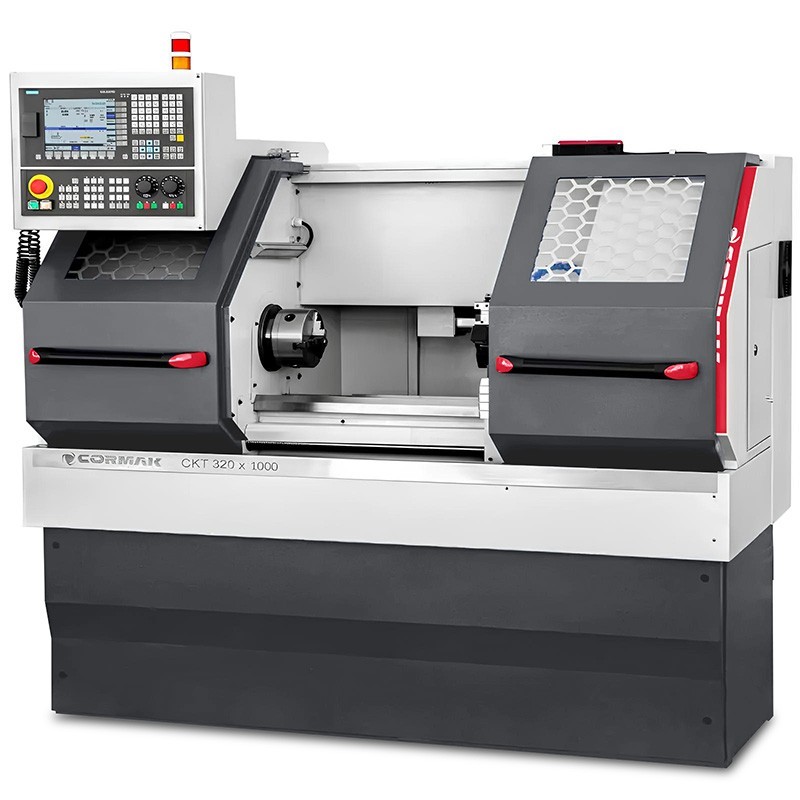
A CNC lathe is a machine controlled by a programme. Axis movements, feed rates and operating parameters are executed automatically in accordance with the pre-set process.
Numerically controlled machines can perform external and internal turning, facing, grooving, drilling, threading and cutting-off.
The greatest advantage of CNC lathes is repeatability. Once the programme has been correctly prepared, subsequent workpieces can be produced with high precision, maintaining very similar parameters throughout the entire batch.
This is particularly important when producing tens, hundreds or thousands of identical parts.
CNC lathes and production efficiency
In batch production, a CNC lathe can significantly reduce the unit production time per part. The operator does not need to manually perform each tool movement, as the machine carries out the programmed sequence automatically.
Additional equipment, such as a bar feeder, an automatic chuck or powered tools, allows the operator’s involvement to be reduced even further.
As a result, CNC lathes are well suited to applications where high productivity, repeatability and components with a high-quality surface finish are essential.
Precision – CNC or conventional lathe?
An experienced operator can achieve very accurate results even on a conventional lathe. The difference is particularly noticeable with larger production runs.
On a CNC machine, the movements of the axes are controlled by the control system. This makes it easier to maintain the dimensions of successive parts with high precision.
With a conventional lathe, the operator must regularly take measurements and make adjustments manually. For a single workpiece, this is not a major issue, but when dealing with hundreds of components, it affects production time.
Which lathe should you choose for your workshop?
If the workshop mainly carries out repairs, refurbishments and produces individual parts, a conventional lathe will be a practical and cost-effective solution.
If the company plans to expand into batch production, manufacture complex parts and increase automation, a CNC lathe offers far greater possibilities.
In many workshops, the best solution is to have both types of machine. A conventional lathe handles quick and non-standard jobs, whilst a CNC lathe carries out repeatable batch production.
What specifications should you look out for?
Before purchasing, you should compare not only the type of control system but also the machine’s actual operating parameters. The following are of key importance:
- maximum turning diameter,
- turning length,
- turning diameter over the tailstock,
- spindle bore,
- speed range,
- motor power,
- structural rigidity,
- compatibility with additional equipment.
Only by comparing this data with the type of workpieces being produced can one select a machine that will meet the workshop’s actual needs.
Summary
The choice between a conventional lathe and a CNC lathe should be based on the nature of production. For one-off parts, repairs and frequent changes in orders, it is worth choosing a conventional lathe.
For larger production runs, high requirements for repeatability and increasing automation, numerically controlled (CNC) lathes offer the advantage.
Before purchasing, you should also compare the turning length, turning diameter, spindle bore, speed range and power of the machine. Only by combining these parameters with the workshop’s actual needs can you select a lathe that will ensure high quality and adequate productivity.
