

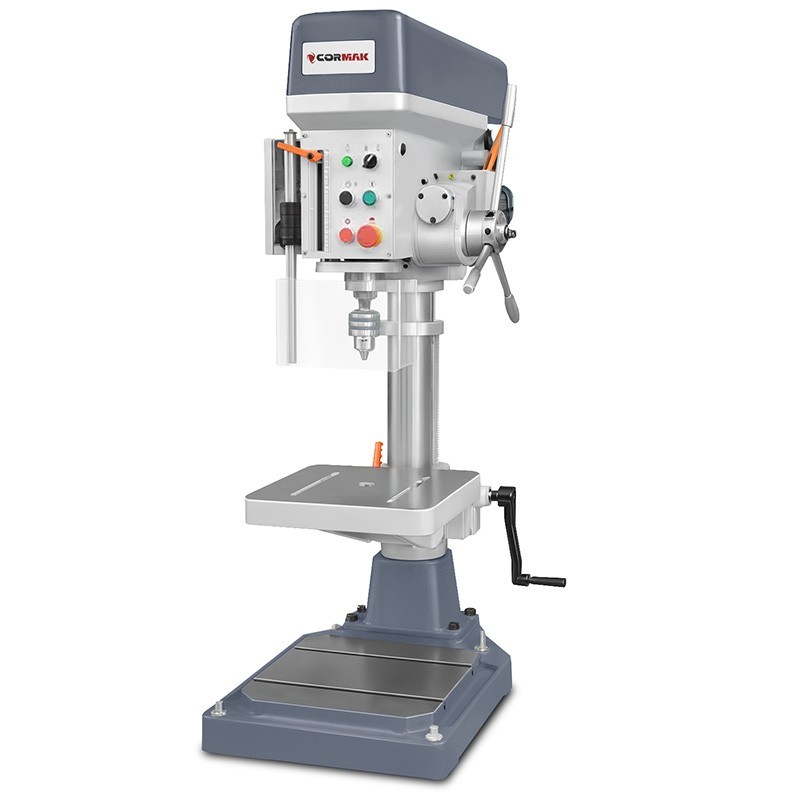
A hand-feed drill works well for individual holes, repair work and small batches. The operator controls the pressure on the tool and the rate at which it penetrates the material. However, in high-volume production and when drilling many similar holes, this approach can limit productivity.
A manual feed drill works well for single holes, repair work and small batches. The operator controls the pressure on the tool and the rate at which it penetrates the material. However, in high-volume production and when drilling many similar holes, this approach can limit productivity.
In such circumstances, it is worth considering a drill with automatic feed. The machine automatically moves the spindle at a set speed, making the drilling process more repeatable, less dependent on the operator and more comfortable during long shifts.
How does automatic feed work?
In a conventional drill, the spindle is lowered manually using a lever. In a model with automatic feed, the working movement is performed mechanically, in accordance with the set feed rate.
Depending on the machine’s design, the operator can select one of several feed rates. This allows the parameters to be adjusted to the drill bit diameter, the type of material, the hole depth and the required machining quality.
Once the workpiece has been positioned and the process started, the spindle moves at a steady rate. The operator does not need to hold the lever at all times, which is particularly important when drilling holes in batches.
When does automatic feed increase productivity?
Automatic feed offers its greatest advantage during batch production. If a workshop is producing several dozen or several hundred similar holes, even a slight reduction in the duration of a single cycle can noticeably improve the productivity of the entire workstation.
Automatic feed is particularly effective for:
- batch drilling,
- thick steel workpieces,
- larger drilling diameters,
- deep holes,
- intensive multi-shift work,
- production requiring repeatable parameters.
For one-off workshop jobs, the difference may be negligible. In repetitive production, however, automation begins to have a real impact on work organisation and the rate at which subsequent parts are produced.
Improved drilling repeatability
With manual feed, the down-force depends on the operator. It can vary depending on the operator’s fatigue, experience or the type of material being machined. Too much down-force can accelerate tool wear, whilst too little can lengthen the drilling cycle.
Automatic feed helps maintain more stable cutting conditions. Subsequent holes are drilled using similar parameters, which improves process repeatability and facilitates quality control.
This is particularly important when a large number of identical parts are produced in a single batch, and each hole must have similar geometry and surface quality.
Automatic feed for large diameters
The larger the drill bit diameter, the greater the forces acting during machining. When drilling by hand, the operator must maintain the correct pressure throughout the entire cycle, which can be tiring when working with large diameters and harder materials.
Automatic feed reduces this effort and ensures the tool is guided evenly. This helps maintain a stable drilling process, particularly for deeper holes and thicker steel components.
However, the feed function alone is not sufficient for demanding machining operations. The drill should also have adequate motor power, a rigid structure, the correct spindle taper and a wide range of rotational speeds.
Reduced strain on the operator
During repetitive drilling, an operator performs hundreds of similar lever movements. After a few hours, this can lead to fatigue and a drop in work rate.
Automatic feed takes over the spindle’s working motion. The operator can focus on positioning workpieces, changing tools, quality control and the safe operation of the workstation.
Improved workstation ergonomics can therefore lead to greater productivity throughout the entire shift, particularly in workshops where drilling is a regular part of the production process.
When is manual feed sufficient?
Not every company needs an automatic solution. Manual feed will suffice for repair work, prototypes, small batches and occasional drilling.
If the type of workpiece, drilling diameter and material change frequently, manual control may be more convenient. The operator then has greater freedom to adjust the pressure to suit the specific situation.
Automatic feed is most cost-effective where the process is repetitive and the machine performs similar operations for a significant part of the working day.
What should you look out for when buying?
Before choosing a drill, it is worth checking the available feed rates, maximum drilling diameter, spindle stroke, motor power and speed range. The type of spindle, the stability of the worktable and the ability to securely clamp the workpiece are also important.
During intensive use, a cooling system is also a major advantage, as it helps dissipate heat and improves the tool’s operating conditions. Cooling can be particularly important when drilling in steel, making deeper holes and working with larger diameters.
It is also worth assessing whether the automatic feed range is suitable for the most frequently performed operations. The machine should be selected to suit the workshop’s actual tasks, rather than solely on the basis of the highest parameter specified in the technical data.
Summary
A drill press with automatic feed is a good choice, particularly for batch and intensive drilling. It ensures a more uniform spindle movement, improves repeatability and reduces operator effort.
For individual holes, manual feed may suffice. However, if the drilling machine is in daily use and performs a large number of similar operations, the additional cost of automatic feed can quickly translate into higher production output, improved ergonomics and more consistent hole quality.
