

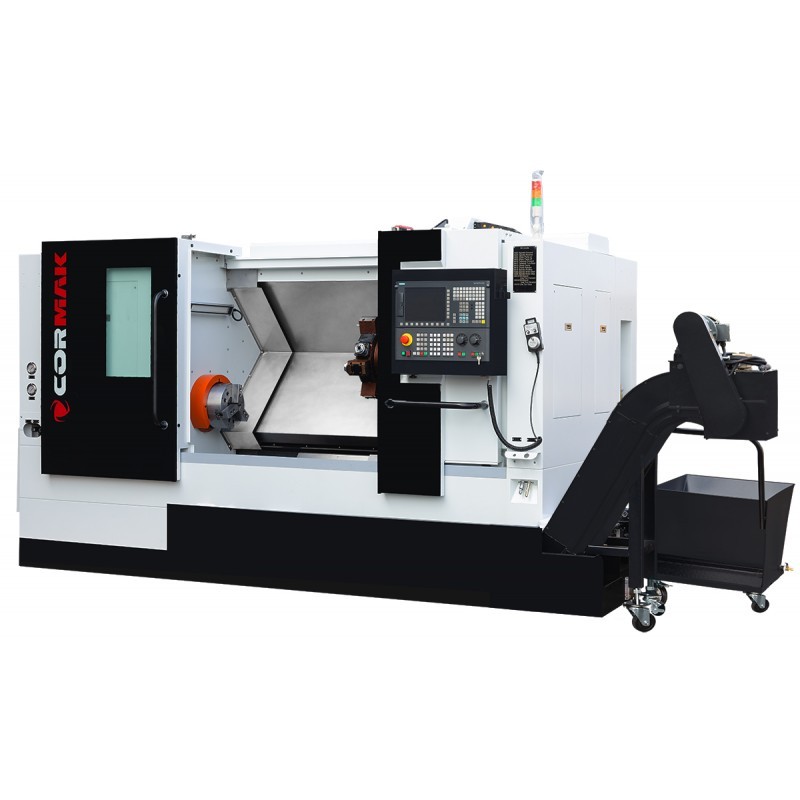
A bar feeder for a CNC lathe automates the feeding of material to the spindle and enables the production of successive workpieces without the need to load each bar manually. It is primarily used in the production of bushings, mandrels, bolts, fittings, spigots, hydraulic components and parts made from round, hexagonal or profiled bars.
A bar feeder for a CNC lathe automates the feeding of material to the spindle and allows successive workpieces to be machined without having to load each section manually. It is primarily used in the production of bushings, mandrels, screws, fittings, spigots, hydraulic components and parts made from round, hexagonal or profiled bars.
Purchasing a bar feeder is not always necessary. It offers the greatest benefits in batch production, where parts are repetitive, cycle times are relatively short, and frequent stops to the lathe limit its productivity. Factors determining cost-effectiveness include, amongst others, the number of parts, the diameter of the bars, machining time, the length of the material and the capabilities of the CNC lathe itself.
How does a bar feeder work?
The material is placed in the feeder positioned behind the lathe’s headstock. The device feeds the bar through the spindle bore into a chuck, collet or other clamping system. Once the material is clamped, the lathe performs the programmed operations, such as turning, drilling, threading, grooving and cutting off.
Once the cycle is complete, the finished workpiece is cut off, the chuck releases the material, and the feeder advances the bar by a set length. The machine then begins the next cycle. The process can be repeated until the bar is used up or the planned number of pieces is reached.
Depending on the design, the feeder can handle short lengths or automatically retrieve successive bars from the magazine. More sophisticated systems allow for longer periods of operation with minimal operator intervention, provided that the machining process is stable and well prepared.
When does a feeder increase productivity?
The greatest benefit is the reduction in set-up time. With manual operation, the operator must stop the machine, open the chuck, remove the remaining material, load a new section, set the bar feed length and restart the programme. If a single workpiece is machined for several tens of seconds or a few minutes, such interruptions can account for a significant proportion of the entire process.
A bar feeder for a CNC lathe will be particularly useful when:
- large or regularly recurring batches are being produced,
- multiple identical parts are produced from a single bar,
- the machining time for a single workpiece is short,
- the lathe frequently stops due to manual material changes,
- production is to be carried out over several shifts,
- the company wishes to minimise the operator’s involvement in repetitive tasks.
Automation is particularly important in the production of components with small and medium diameters. A single long bar can be used to produce many parts without the machine having to stop after each cycle. The shorter the machining time per part, the greater the proportion of the process taken up by loading operations.
Less downtime and better utilisation of the lathe
A CNC lathe generates value primarily when it is machining. Every interruption for manual loading reduces the machine’s utilisation. A feeder allows for extended automatic operation and increases the number of workpieces produced during a single shift.
The operator does not need to remain at the machine at all times. They can check the quality of parts, prepare tools, operate another workstation or replenish material on another machine. In a well-organised production environment, a single person can supervise more than one machine.
A feeder can also facilitate night-time or partially unattended operation. However, this requires a reliable programme, effective removal of finished parts, tool monitoring and protection against the build-up of swarf. Automatic material feeding does not replace correct processing techniques, but it can significantly improve the organisation of a stable production process.
Repeatability of material feed
Manual positioning of the bar can result in variations in its feed-out. The feeder carries out this movement according to a set programme, which is why successive workpieces begin machining from the same position. This improves process repeatability and reduces material wastage.
This is particularly important with short workpieces, where even a small amount of excess left on each workpiece can increase bar consumption across the entire batch. A correctly configured system also allows you to monitor the length of the remaining material and minimise the number of errors resulting from the bar being loaded incorrectly.
Short feeder or magazine feeder?
Simpler feeders handle short bar lengths. They take up less space and can be a good solution for workshops that do not require long periods of unattended operation. Shorter material is easier to feed and may generate less vibration at high spindle speeds.
Magazine feeders handle long bars and automatically feed the next pieces. They provide greater autonomy for the workstation but require more space behind the lathe. It is also important to ensure correct material guidance, a well-fitted guide channel, bar stabilisation and communication with the machine control system.
When might a feeder not be cost-effective?
Automation does not always guarantee a quick return on investment. In single-piece production or very short runs, the time taken to set up the feeder may be similar to the time needed to load the material manually.
A feeder will also be less useful if the company frequently changes bar diameters, and each batch requires a different guide channel and additional adjustment. The benefits may also be limited where machining times are long. If it takes several hours to machine a single part, manual material changeover accounts for only a small proportion of the entire cycle.
How do you choose a feeder for a CNC lathe?
First, check the spindle bore diameter and the range of bars supported. The feeder must be compatible with the lathe, its control system, chuck and clamping system. The maximum material length, the type of bars and the available space behind the machine are also important.
When making your selection, you must take into account:
- the minimum and maximum bar diameters,
- the length of the material,
- spindle speed,
- the type of chuck or collet,
- the ability to communicate with the lathe,
- changeover time,
- method of removing finished parts,
- available space behind the headstock.
At high speeds, correct bar guidance is particularly important. An ill-fitting channel can cause vibrations, noise and a deterioration in surface quality. It is also worth checking whether the feeder allows for convenient changeover when changing the diameter.
Summary
A bar feeder for a CNC lathe is worth using when the machine regularly produces repeatable parts from bars, and manual material replacement causes frequent downtime. Automatic feeding increases the utilisation of the lathe, improves repeatability and allows the operator to oversee more than one workstation.
The greatest benefits are realised in the batch production of short workpieces. For small batches, frequent material changes and long machining times, simpler manual operation may remain more cost-effective. The choice of feeder should be based on the actual production programme, bar diameter, cycle time and the capabilities of the specific CNC lathe.
