

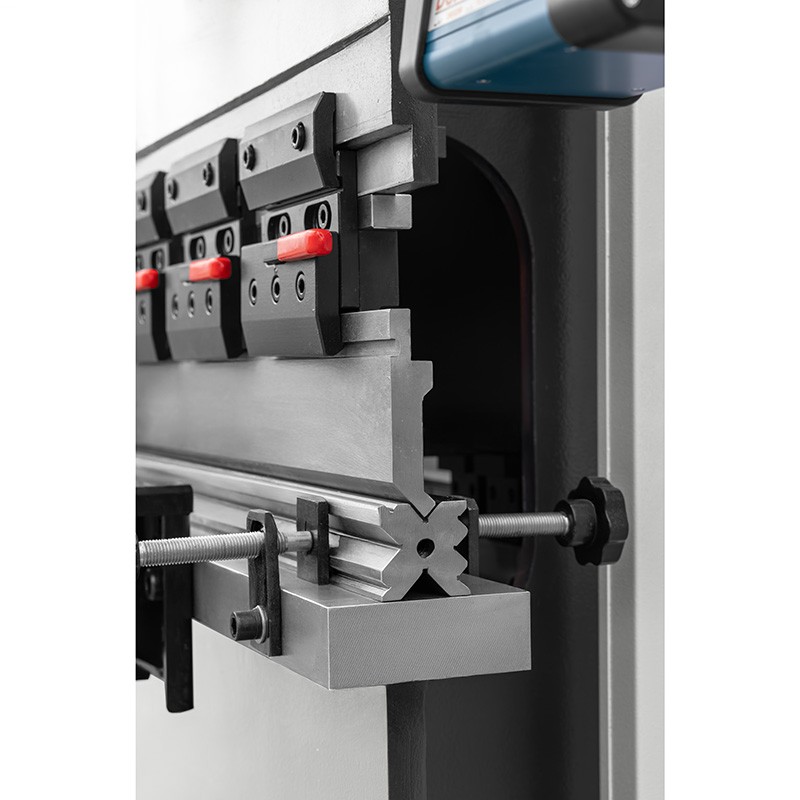
Press brake dies are the basic tools used in the process of precision sheet metal bending. Working in conjunction with the die, they enable metal sheets to be formed into specific shapes and angles.
Press brake dies are the basic tools used in the process of precision sheet metal bending. Working in conjunction with the die, they enable metal sheets to be formed into specific shapes and angles.
Every modern press brake, and particularly a CNC press brake, requires a set of tools selected to suit the material, the workpiece geometry and the bending technology. The repeatability, productivity and final quality of the product depend on the quality of these tools and their correct fit.
What are press brake punches?
A press brake punch is the upper working tool that presses down on the sheet metal and forces it into a suitably selected die. This allows the required angle, radius and bend geometry to be achieved.
In practice, the punch does not operate on its own. It forms a technological system comprising the die, the press brake and process parameters such as pressing force, stop positioning and bend length. Correct alignment of these elements minimises the risk of material damage and ensures the required accuracy is maintained.
Why are punches crucial in sheet metal bending?
Bending sheet metal and metal sheets requires a high degree of accuracy. Even a slight deviation in angle, radius or positioning can affect the assembly of the entire component. Therefore, the correct selection of punches and dies is crucial for process stability.
A well-chosen punch helps to ensure:
- high production repeatability;
- maintenance of the required bending angles;
- minimisation of scrap and rework;
- a lower risk of marks, cracks and material deformation;
- the required surface quality and part geometry.
When combined with numerical control, it is possible to achieve consistent results in both single-piece and batch production.
CNC press brakes – precision and automation
Modern CNC press brakes allow for precise control of bending parameters and the automation of successive stages of the process. The operator can programme the position of the stops, the depth of the beam’s travel, the bending angle and other settings specific to the part in question.
The use of CNC in bending processes enables, amongst other things:
- automatic adjustment of the angle and pressing force;
- compensation for or control of material springback;
- streamlining the operator’s work;
- reducing set-up and production times;
- improved production repeatability.
This enables companies to carry out both short runs and repeat production whilst maintaining high precision.
Types of punches for press brakes
Universal dies
These are often used in standard sheet metal bending operations. They work well with typical angles and simple workpieces, and their versatility makes them suitable for a wide range of everyday tasks.
Segmented dies
They consist of sections of varying lengths, allowing the tool to be flexibly adapted to the geometry of the workpiece. They are particularly useful for components with more complex shapes.
Specialised dies
These are designed for specific technological applications, for example:
- multi-pass bending;
- bending of closed profiles;
- bending with embossing;
- workpieces with non-standard geometries.
Radial punches
These are used where a larger bending radius is required or where the material requires gentler forming. They can be useful, amongst other things, when working with aluminium and other materials prone to surface deformation.
How to select the right die?
The choice of tool has a direct impact on the quality of the bend, productivity and tool life. When planning the process, it is worth taking several key factors into account.
Material
Different materials have different properties. Stainless steel, aluminium and structural steel differ, amongst other things, in terms of strength, behaviour during bending and susceptibility to springback.
Sheet thickness
As the thickness of the material increases, so do the loads acting on the tools and the press. This affects the required selection of punch, die and pressing force.
Bending angle and radius
In practice, angles of 30°, 45° and 90° are frequently used, but design requirements may also call for specialised solutions. The shape of the punch and the selection of the die should correspond to the required geometry and the characteristics of the material.
Tool compatibility
The punch and die must be properly matched. It is also necessary to check that the clamping system is compatible with the press brake in use and to consider any limitations arising from the workpiece’s design.
The importance of tool quality
High-quality punches for press brakes are usually made from tool steel with the appropriate hardness and wear resistance. The quality of manufacture has a direct impact on process stability and the service life of the tooling.
Good tools help to achieve:
- a longer service life when used correctly;
- greater resistance to wear;
- more stable operating conditions;
- a lower risk of production errors;
- reduced costs arising from rework and scrap.
The most common errors in bending processes
Problems in the bending process may arise from incorrect tool selection, machine settings or material properties. The most common include:
- incorrect bending angle;
- material cracks;
- workpiece deformation;
- marks on the sheet metal surface;
- insufficient repeatability between workpieces.
Therefore, both the operator’s experience and the correct use of the functions offered by the CNC press brake are important. Before commencing mass production, it is advisable to carry out test bends and verify the parameters obtained.
How should punches and dies be maintained?
Regular maintenance of the tools is crucial for their longevity and for maintaining consistent bending quality. Proper maintenance includes:
- cleaning the tools after use;
- storing them in dry and secure conditions;
- regular checks for wear and damage;
- avoiding overloading and operating outside the permissible parameters;
- following the correct procedures for fitting and replacing tools.
Well-maintained punches and dies promote workplace safety and help maintain the required production quality.
CNC punch versus universal punch – a comparison
| Feature | Universal punch | Punch selected for the CNC process |
|---|---|---|
| Range of applications | Typical, simple bends | Bends with specific geometry and repeatable technology |
| Flexibility | High for standard workpieces | Depends on the designed application |
| Repeatability | Depends on the choice of tool and settings | Supported by CNC programme parameters |
| Selection | Requires analysis of the material and geometry | Requires analysis of the material, geometry and bending programme |
Summary
Press brake dies play a key role in modern metalworking. When combined with a suitably selected die, CNC technology and the correct parameters, they enable precise bending and streamline the entire production process.
Regardless of whether a facility uses conventional press brakes or advanced CNC systems, investing in tools tailored to the application is the foundation of consistent quality. Proper selection, maintenance and knowledge of the technology help to increase production efficiency and minimise material wastage.
